Small Town Papers, Big Digital Archive: NYS Historic Newsapers
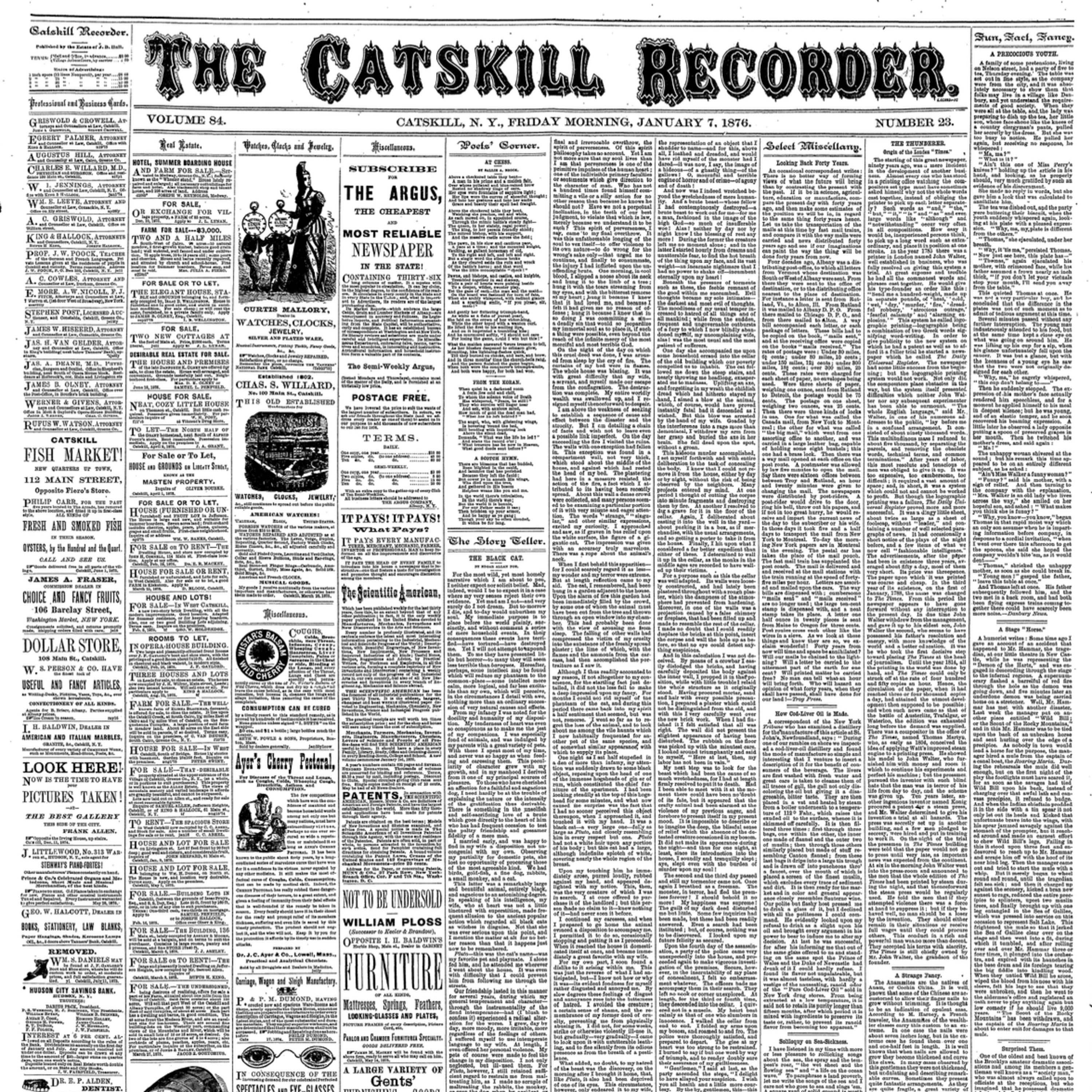


New York State Historic Newspapers Project with Chuck Henry
Episode Overview
Dive into the largest state newspaper archive in the country! Chuck Henry, Project Lead for New York State Historic Newspapers, takes us through this incredible digital repository containing over 1,200 newspaper titles, 1.5 million editions, and more than 15 million pages—all available free of charge.
Guest
Chuck Henry
IT Coordinator, Northern New York Library Network
Project Lead, New York State Historic Newspapers
What You'll Learn
- How the project transformed microfilm archives into a searchable digital collection
- The breadth of the collection: from 1725 to 2025, covering all 62 New York counties
- Tips and tricks for searching the database effectively
- Why this matters for genealogists, historians, students, and curious locals
- The difference between this free public resource and commercial databases
- How libraries and historical societies can get their collections digitized
Key Topics Discussed
- The Problem with Microfilm
- Chuck explains why libraries desperately needed a better solution than basement microfilm readers and hours of manual searching.
- Building the Archive
- Started in 2004 as Northern New York Historic Newspapers
- Expanded statewide in 2014
- Now adds approximately 500,000 new pages every year
- Second largest freely available newspaper archive in the U.S. (behind Library of Congress)
What's in the Collection
- 1,200+ newspaper titles from across New York State
- Earliest: New York Gazette (February 1725)
- Most recent: Freeport High School newspaper (June 2025)
- Includes Catskills papers like the Catskill Mountain News, Delaware County Dairyman, Gilboa Monitor, and Callicoon Local Record
- Multiple languages: English, German, Spanish, Italian, Gaelic, and Native languages
Search Tips from the Expert
- Start with county-based browsing using the interactive map
- Use Boolean search operators and quotation marks for precise results
- Try alternative spellings for older papers with imperfect OCR
- Browse by specific dates to see multiple newspapers' coverage of historical events
- Create a free account to save searches and make notes
Who Uses It
- Genealogists researching births, deaths, marriages, and property transfers
- Amateur and professional historians
- Students from K-12 through university level
- Authors and journalists
- Local communities preserving their heritage
The Process
- Libraries and historical societies can submit their collections
- Funding often available through Empire State Library Network councils
- Scanning done in-house in Potsdam, NY
- OCR technology makes everything searchable
- Original microfilm preserved as permanent backup
Notable Finds Mentioned
- Desperate fight with a bear (Stanford Mirror, 1876)
- Bootleg liquor tragedy (Delaware Republican, 1926)
- Restaurant ads from the 1970s
- The "Spiedie Sandwich" historical marker project
Copyright and Access
- Content pre-1920s is public domain
- 1920s-1960s content varies by copyright status
- Post-1960s content requires written permission
- Everything available free of charge—no paywalls or subscriptions
Resources
New York State Historic Newspapers
Get Involved
- Libraries and historical societies can contact the Northern New York Library Network about digitization services
- Create a free account to save searches and research
- Optional monthly newsletter available
🎙️ Production Credits
Kaatscast is a biweekly production of Silver Hollow Audio
Host, producer: Brett Barry
Transcription: Jerome Kazlauskas
More at kaatscast.com
Sponsored by The Mountain Eagle
Mystery Bonus
Do you know where the Mountain Eagle's missing archives are? Previous owners either destroyed them or the microfilm is languishing in an undisclosed ... basement? Contact the show if you have leads!
Transcript by Jerome Kazlauskas
[00:00:00] Chuck Henry: The New York State Library estimates that there's over 10,000 titles in New York State. It seems like that was a fixture for small towns. Like, the first thing that they do to feel like a real town is say, "Let's have a newspaper," and somebody establishes a newspaper.
[00:00:21] Brett Barry: The New York State Historic Newspapers Project is a digital repository for more than 1,200 of those 10,000 New York newspapers, comprising about a million and a half editions and more than 15 million pages, and you can read every one of them free of charge. Welcome to "Kaatscast: The Catskills Podcast." I'm Brett Barry, and today, we are talking with Chuck Henry, project lead for New York State Historic Newspapers, where you can search up stories from old Catskill papers like The Catskill Mountain News, The Delaware County Dairyman, The Gilboa Monitor, or The Callicoon Local Record, and the list goes on. Just make sure you've got some time set aside because once you start searching, it's hard to stop. This treasure trove of local stories, announcements, and display ads is the ultimate rabbit hole, from above-the-fold headlines to back-page classifieds, and you don't even have to respool the microfilm. Just log on and start paging through. We are going to press with all the details straight from Chuck Henry himself, who's got the inside scoop on this digital archive of New York history.
[00:01:42] Chuck Henry: My name is Chuck Henry. I'm the IT coordinator for The Northern New York Library Network and project lead for the New York State Historic Newspapers.
[00:01:52] Brett Barry: Now, you have a background in elementary education, and you have your master's in instructional technology and media management, so that dovetails nicely into this project, which seems pretty extensive. Tell me about The Northern New York Library Network and how this all came about.
[00:02:10] Chuck Henry: The Northern New York Library Network is a membership organization, and we provide services for libraries and library systems across the northern counties in New York State. This started—the newspaper project started because we were asking our membership what they needed, and one of the things that we kept hearing from them was that microfilm is terrible. Basically in the early eighties and mid-to-late eighties, a bunch of microfilm was produced by the state in an attempt to get paper newspapers photographed and on microfilm so that they could be preserved for future generations, and that's great, but the film is terrible to deal with if you've ever worked with microfilm. Microfilm is hard to put on a reader. It's hard to use, and it takes time to look to scan for things because you're literally just looking page by page. Libraries felt that they needed a way to make it easier for patrons to have access to this film and to get access to these newspapers, and that was something that we felt that we could do, so in 2004, we launched a Northern New York Historic Newspaper website, and that covered again just the northern counties of the state, and it was extremely popular, and then, as time went on, more of our sister councils from across the state wanted to do the same thing, and so in 2014, we decided to create the New York State Historic Newspapers. I was hired to run this. My skills are mostly in Linux and server maintenance as well as the usual image processing and that type of thing, so that's how I got involved originally. These days most of what I do is dealing with our contributors getting film, making sure the film arrives, making sure that we get it scanned, and then getting it back to them safely, as well as doing things like, again, image processing and getting the images finally ready to be able to put on a site itself.
[00:04:18] Brett Barry: As inconvenient as microfilm is, I understand it does have a long shelf life. Is that true?
[00:04:23] Chuck Henry: That's correct. Still to this day, even with digital assets available, the recommendation is still to make sure you have everything on microfilm.
[00:04:33] Brett Barry: So once things are digitized, you want to hold onto that microfilm?
[00:04:36] Chuck Henry: Absolutely, absolutely.
[00:04:38] Brett Barry: For anyone younger than you or me, Chuck, could you explain the process of going down into the basement of the library, which is, I think, usually where those microfilm racks are, and finding an article like what? Take us through what that would entail. I have some recollection of it, and it wasn't pleasant.
[00:05:01] Chuck Henry: That is very true, yeah, so you'd have an idea of a thing that you're looking for. You know, you see this all the time on television and in movies. You go to the wall of microfilm, and you pull out a little spool of film. It looks a little like a movie projector film, except it's tinier. It's only 45 millimeters, so it's a little, little spool, and then you'd have to go find a machine somewhere in the library, and [that machine] then you'd have to just put on and spool the film through the reader to a dummy roll on the other side, and then you'd have to look at the screen, and basically what the machine would do is it would run light through that film and then project it on a big screen for you, and then you'd have to go page by page through every issue of that newspaper, looking for the thing that you're looking for in particular. If you knew the date-ish that that thing happened, it was helpful because then you would be on the right reel. If you did not know, you'd have to go through multiple reels, and it might take hours and hours. That's the part they never show you in movies: how many hours of sitting there that one poor person had to do.
[00:06:18] Brett Barry: Were there indexes, or was it really up to the user to ferret this material out?
[00:06:24] Chuck Henry: Generally that's true that it would be up to the user. The box that the reel of film came in has a label on it, and sometimes that label was useful, and sometimes it was not.
[00:06:36] Brett Barry: So there are other companies, I guess commercial databases, that do this kind of thing, like newspapers.com. How is what you are doing different as, I assume, a nonprofit?
[00:06:47] Chuck Henry: We are a nonprofit. Well, there's a couple of different ways. I mean, first of all, the results of everything that we scan is publicly available for free. We're not going to charge at any point for this. We are not going to firewall this in any meaningful way, meaning folks have access to it. I mean, these are microfilm reels that were produced with public funds. They're scanned and placed online so that everyone, the public has access to them, so that's a big difference there. We are funded by a couple of different ways. We get a little bit of money from the New York State Government in the form of grants. We also do an in-house microfilm digitization project, and we're aimed primarily at libraries and museums and historical societies who may not have a huge pool of money to work from, and so we do microfilm digitization here in-house for a very affordable rate, and we work very well with libraries because we know libraries very well, and so that's where our funding comes from to be able to do this work, and so far, we have about 180 contributors across the entire state who are academic libraries, public libraries, public library systems, museums, and historical societies.
[00:08:10] Brett Barry: So if a library or historical society has a collection of newspapers, either on microfilm or even the original newspaper print. What's the process? How do they get it digitized? Do they approach you? Do you approach them? How does that relationship work?
[00:08:28] Chuck Henry: Generally speaking, we don't approach them.
[00:08:31] Brett Barry: You have enough on your plate?
[00:08:33] Chuck Henry: Oh, we do, we very much do. At any point, we have between 40 and 80 projects in-house running at any given moment, so generally speaking, if you're a museum or historical society or a library and you've got material that you think your patrons or your community would be interested in. Then, the first thing to do is to figure out what titles and what information is going to be of most use to your folks. Once you've identified that, the next trick is finding funding to be able to do the work. Scanning from paper to digital is the most expensive because it requires the most level of handling. From microfilm to digital is less expensive and easier to do, but you have to have the existing microfilm in-house, so once you've figured out what it is you want to have scanned, finding funding is the next place to go. In the library world, there are other councils just like us. We are a part of what's called The Reference and Research Library Resources Council, which is a mouthful, so we call ourselves The Empire State Library Network. Every library in New York State has access to their local Empire State Library Network Council, and that council very often has grant funding available to help out. Typically what happens is those libraries will reach out to their council. Their council will help them with the funding, getting the funding together, and then pass them along to us. That's the point that I start talking to the folks from the library—they have funding, and they have film. We start talking about how to arrange things and get the film up here to the Potsdam area.
[00:10:22] Brett Barry: Yeah, so Potsdam, I mean, I like to do interviews in person, but when I found out how far north you actually are from the Catskills, we went with a remote interview, but Potsdam, it looks to me on the map that it just eeks out the county next to it as possibly the most northern county in New York?
[00:10:41] Chuck Henry: Yes.
[00:10:41] Brett Barry: Yeah.
[00:10:42] Chuck Henry: Absolutely, absolutely, we're about 45 minutes from Ottawa, if that tells you anything.
[00:10:48] Brett Barry: So why Potsdam?
[00:10:51] Chuck Henry: I think one of the things that's interesting about the North Country in general is that we have a lot of organizations in the North Country who are very independent and very rugged. They have a tendency to stand on their own as much as possible, and so as an organization that supports them, that means that we need to be creative in how we find ways to support these organizations, and one of the beauties too is that because we are being creative and being innovative, how we support these organizations allows us to experiment a little bit, and the newspapers really did come from an experiment. We weren't a hundred percent sure when we started that a newspaper archive like this was going to be viable, especially for the North Country. Once we got started, it became clear that it was super useful to folks. Genealogists and amateur historians really, really love the site and use it quite a lot, and then still to this day, even though we're a statewide newspaper site, a lot of our traffic still comes from the North Country, surprisingly. So it was really, I think, because we had the freedom to innovate. That is why we started it in the first place.
[00:12:14] Brett Barry: So you talked just now about researchers using it. Can you give a sense of who's using the collection? I would imagine historians, journalists, genealogists...
[00:12:24] Chuck Henry: Absolutely.
[00:12:25] Brett Barry: What are you seeing?
[00:12:26] Chuck Henry: All of the above. Genealogists are a large, large portion of our traffic, I believe, in a lot of ways. Newspapers, if you think about it, are a great source for births and deaths and marriage announcements, arrests, property transfers, and all of this rich material that people love in genealogy, so that's a huge crew there too. History researchers are the other folks who are writing articles for historical societies. Folks who were writing books were credited in an awful lot of books because people just use us as primary source material, and we also get an awful lot of students as well, K-12 as well as academic students, and for strange projects as well. We had one project that was from the Union-Endicott Central School District, where a bunch of students, as part of a group project, wanted to set up a historical marker in their town about the spiedie sandwich being a culturally significant dish to the Binghamton area, and so they used our site to find, you know, early references to spiedie sandwiches, which was a strange thing for us.
[00:13:43] Brett Barry: Yeah, so what's the breadth of this collection? I understand it started in 2004 as Northern New York Historic Newspapers.
[00:13:51] Chuck Henry: Mm-hmm.
[00:13:51] Brett Barry: 10 years later, it was rebranded as New York State Historic Newspapers, so now you're covering all 62 counties of New York State?
[00:13:58] Chuck Henry: Correct.
[00:13:59] Brett Barry: And according to your site as of this moment, the collection contains 1,486,764 issues comprising 15,242,090 pages. Tell me about the actual newspapers that you house digitally, of course.
[00:14:18] Chuck Henry: Sure, we have more than 1,200 titles, and we add about half a million new pages every year. Our earliest title at the moment is The New York Gazette from February of 1725, and our most recent issue is from the Freeport High School on Long Island. They're a high school newspaper, and that was June of 2025, so, you know, one of the things that we like to say is that we're the largest state newspaper archive in the country, which is true. We are the second largest freely available newspaper archive behind the Library of Congress in the United States.
[00:15:03] Brett Barry: Wow!
[00:15:04] Chuck Henry: So it's a big deal. It's one of those things where it's interesting to be in conversation with the Library of Congress because they're aware of us, and, you know, they, for a while, ran the same software that we did, and so we consult back and forth, but it's a big project. It's a really interesting project.
[00:15:23] Brett Barry: And one of the most recognizable newspapers for me would be The Catskill Mountain News, which comes up if I click on Delaware County on the New York map, and so Catskill Mountain News, you have everything—well, maybe not everything, but you have from the years 1902 to 1985. Is that complete?
[00:15:39] Chuck Henry: You know, I wouldn't be able to tell you off the top of my head.
[00:15:42] Brett Barry: You don't know the stats for every single newspaper in the collection?
[00:15:46] Chuck Henry: Strangely enough, I do not. Actually, you know, it's one of those things where it's an interesting bit of knowledge about New York State being as old a state as we have. The New York State Library estimates that there's over 10,000 titles in New York State. We only have 1,200 of them, so it's one of those things where there are titles everywhere. It seems like that was like a fixture for small towns. You know, we're going to found this town. We set up our town, and like the first thing that they do to feel like a real town is say, "Let's have a newspaper," and somebody establishes a newspaper, so there's newspapers from almost every town, and so it—yeah, I don't know the depth and breadth of everything that's out there. The other thing to keep in mind about newspapers is that newspapers have a tendency to change the title all the time so The Catskill Mountain News probably had a newspaper or two that were its predecessor, and then there were probably some that have spun off and have become successors as well, so it's kind of interesting. You know, people do genealogy where they're tracking their relationships between various people. I think you could do almost a genealogy of newspapers as well because there are ancestors and descendants for absolutely every title in the state as well, to some degree.
[00:17:18] Brett Barry: One of the few newspapers we have left, The Mountain Eagle, is not on this site. Why would a newspaper like that not be listed? What does it take to get them up and running? Is it mostly a financial commitment from their end to be able to fund the digitization of all of those issues?
[00:17:36] Chuck Henry: Yes, I think a lot of times small newspapers are struggling right now, and so one of the things that they hope to do is monetize their content as much as possible, so if you're a small live newspaper right now, taking your back archives and finding some way to make money out of it is definitely possible. You know, it's one of the things that's kind of imperative, and so a lot of times these small organizations will sell the rights to their archives to something like NewsBank. NewsBank is an organization, a company that—that's what they do. They sell access to archives, and I, you know, I don't fault any newspaper for doing that. If you're a small newspaper and you desperately need to stay afloat, monetizing your archives makes sense, but not everybody makes that decision. We have newspapers like The Plattsburgh Press-Republican and The Saranac Lake Adirondack Daily Enterprise, who actually use us as their archives because if they're not willing to monetize their archives, then they have to post them on their website in some way, in which case it's costing them money as well, so in the case of The Adirondack Daily Enterprise, it was actually more affordable for them to have us house their archives than it was for them to put it online in some way, somehow, themselves, and so we have a working relationship, and we've got a few titles across the state where we have that working relationship with them.
[00:19:08] Brett Barry: But most of the papers that you have in the collection, I guess, are out of print or defunct or...
[00:19:15] Chuck Henry: For the most part, yeah.
[00:19:16] Brett Barry: Yeah.
[00:19:17] Chuck Henry: Absolutely. For us, one of the things that your listeners might notice about the website is that a vast majority of our content is before the 1920s, and the reason for that is because papers ahead of the 1920s are in the public domain, so that means we don't have to ask anyone in particular for permission. Between the 1920s and the 1960s, they might be in the public domain depending on whether or not the publisher at the time protected their copyright, and so we have an awful lot of titles that fall into that category, and anything we have post-early 1960s, we have written permission from the publisher or the owner of the paper for that access, so a vast majority of our content is older, but we do have quite a bit of content from the 1920s onwards.
[00:20:09] Brett Barry: Could you take us through the site a little bit? So if I'm visiting the site for the first time, what are some tips and tricks from the person behind this whole thing? We have a unique opportunity here for some help in navigating this giant collection of newspapers. Someone in the Catskills mostly would be interested in probably Ulster, Delaware, Greene, Schoharie, and Sullivan counties. How do you begin to research what's available and to have a look around?
[00:20:42] Chuck Henry: Well, probably the easiest way is just thinking about it from a county standpoint, like you just mentioned. If you land on our homepage, there's a beautiful map of New York State available on the front page. You can just click on whatever county you want to start with, in which case when you click on that county, it will move to another page where you get a list of all of the other counties on one side and a search box on the other, in which case then if you want to add more counties, you can go down through the list and click off extra counties you want to add to that search, and they'll turn red, so that way you've got this nice little indicator that, you know, you're searching through those areas, so you can search through any of the counties you just mentioned very easily by doing that, and then you go to that text box at the top and start punching in what your search might be. A lot of people start with just a name search. You know, especially if you're a genealogist and you're looking for a relative in particular, you can go ahead and just type their name in there. There are all sorts of other tricks and tips involved in that as well because once you do that search, you will land on a results page, and then from there, on that results page, you can also then start restricting by the date, so that way, if you're looking for someone that you know is in the 1800s, you can stop searching the 20th century. You can do that type of focusing for the next screen as well. There also is the ability to do what's called advanced searching. For those of us of a certain age, we remember what the internet was like before Google. In our case, our search uses the old Boolean-style searching, so Boolean is a language for describing search terms, and it allows you more control, so, for instance, if you're searching for Chuck Henry specifically, you can put quotes around that, in which case you'll find just results for "Chuck Henry" together next to each other in a way. If you leave the quotes off, you'll find every page that has "Chuck" and "Henry" somewhere on the page together. There's an ad from The Adirondack Daily Enterprise from the eighties for the Grand Union supermarket where they were advertising their chuck roast amounts, and my father happened to be the assistant manager, and his name was on the ad, in which case then that page comes up because Chuck Roseton and Lonnie Henry were together on the same page, and putting the quotes around it limits it to just that. We have a help file there that allows you to read some more information about those search terms, and so that's a great way to get more specific in your searches. Another great way to browse the site is that we have a full list of all of the titles in the state, and you can just pick a newspaper at random, and then it'll drill down into the date range, and you can pick a date range that you want to look at. You can also search those titles specifically from those pages, so if you're interested in something that you feel might be a Clinton County item, you could find The Plattsburgh Press-Republican, for instance, and search just "The Plattsburgh Press-Republican" for results as well. In the last way of dates, it's really interesting to pick a particular date in history and go see what exists for newspapers for that particular time period. We have, in the toolbar across the top, a date category. You click on that date and then go find a decade: a year, a month, a day, and see what newspapers were there and what each newspaper was talking about. There's some really interesting ways that you can look at events like the end of World War II or assassination attempts on presidents or what have you by doing that, by zooming in onto a particular date, and then reading newspapers from all over New York State and their perspective on that.
[00:24:47] Brett Barry: So newspapers are published on different days of the week. I just popped in my own birthday, and three newspapers came up that were published on that day. I've never heard of any of them. They've got The Palladium-Times, The Le Moyne College Dolphin & Piper, and Deutscher Wochenspiegel.
[00:25:06] Chuck Henry: Indeed, there you go.
[00:25:08] Brett Barry: Forgive my pronunciation.
[00:25:10] Chuck Henry: Yep. Oh, we actually have German newspapers, German-language newspapers. We have Spanish-language newspapers, Italian-language newspapers, and one newspaper from the reservation in the North Country, a native language of which I don't know what specifically it was, so we do have other languages available. Oh, I think there's a Gaelic one too.
[00:25:33] Brett Barry: Sticking with the English language papers for a moment, I ran a search for Catskills news 50, 100, and 150 years ago this week. Here's a sampling of what I found. January 11, 1876, from the front page of The Stamford Mirror, "Desperate Fight with a Bear," including some grizzly details about the bear's intrusion into a farm family's pigpen and a fight by Mrs. Butler and her 16-year-old daughter. "The bear held on to the pig until the blows of the women and bites of the dog became too much for him, when it turned on his assailants. It seized the dog and crushed it to death. The girl rained in blows with the ax on the head of the bear, when suddenly bruin made for her. With one sweep of his great paw, he sent her ax flying out of the enclosure and pressed her into one corner. The mother, seeing her daughter's danger, increased the fury of her assault with the mallet, and although the bear got the girl in his embrace, it dropped her before doing her material injury to ward off the attacks of the mother. The floor of the pen was now slippery with blood that was flowing from the wounds of the bear, for the girl had struck him with the edge of the ax and buried it somewhere in the animal every time. When the bear turned on the mother she shouted to her daughter to run to the house and get the rifle. When Jennie was gone her mother succeeded in keeping the bear from getting too close to her, but when the daughter returned with the rifle she was about exhausted, and was fighting from a corner into which the bear was pressing her closely, having disarmed her. Jennie put the barrel of the gun through a chink in the logs and fired." 50 years later... January 9, 1926, The Delaware Republican, "Poison Liquor Kills Four." "Four striking miners who were working as woodcutters at the timber camp of the Thomas Keery Chemical Company at Keeryville, eight miles from Hancock, are dead, and a fifth, blinded and crazed by poison liquor, is said to be wandering in the woods if he has not already died, as the result of a bootleg liquor drinking orgy which culminated Thursday in tragedy," and just 50 years ago in The Catskill Mountain News, Thursday, January 8, 1976, a display ad for Tony's Tropical Pub Steaks, Seafood and Italian Cuisine. We wish all a very happy new year! Friday and Saturday Night Dinner Specials: Baked Stuffed Lobster Dinner - $6.95 | Sliced Filet Mignon Dinner - $5.95 at the foot of Belleayre Mountain just off Route 28 and The New Scandinavian Valley Restaurant-Nightclub-Motel, Route 28, Phoenicia, New York. Open daily for lunch and dinner! "Bar fully open!" Live Entertainment Weekends - Closed Tuesdays. Well, some things don't change. Back to 2026 with Chuck Henry. Once the newspaper's up on the screen, you can actually highlight sections, save sections, and download entire PDFs of the, like, really good quality page PDFs?
[00:29:10] Chuck Henry: Yes.
[00:29:11] Brett Barry: You can save things to your account if you're logged in. I would assume that that's recommended to become a free member, right?
[00:29:20] Chuck Henry: Yeah, that's a new feature for this new website. We moved to new software back in 2023. If you create a free account again, we'll never charge you for that account. Once you have that account, you can save results, so if you find something that's really interesting, you can save results into a little group kind of like a list, and you can leave notes on it as well, so if you're doing research and you find a page that's interesting, you can save it to this list and make notes about why it was an interesting article, and so now you have these kind of stored lists and you can email these lists to yourself, to family members, or to other people that you're working with. Libraries love this a lot because they have local genealogy people, usually at each library, and it's nice for them to be able to create a list of results that they found and email it to a patron who has questions about something, and here's a big important part: we don't market to you unless you ask, so in that creating of an account, if you want to hear more from us, you can click a little check mark box, in which case we'll send you a nice monthly newsletter, but if you don't check that box, then you won't hear from us again.
[00:30:34] Brett Barry: Now everything is searchable, as we've been speaking about. How does that work? That's something called OCR, right, optical character recognition?
[00:30:44] Chuck Henry: Correct.
[00:30:44] Brett Barry: So computers are scanning the physical page and turning that into a different type of word that the computer understands?
[00:30:52] Chuck Henry: Yes, the OCR process is actually pretty complex, and that's the most time-consuming. I think when people think about digitization of newspapers, they think about putting the film on a reel and running it through a machine and the producing of the images. Yeah, that definitely takes time, but the part that takes the most time is that optical character recognition. It's basically a computer reading the squiggles that appear on that page and deciding what letter closely matches and then what word is out of that, and then that's what you're actually searching through. This is actually a place where being a good searcher is more than just typing in a word and hoping for the best because it is possible that OCR is incorrect, and so trying different spellings very often will get you some different results, especially when the papers are particularly old and the images were not great to begin with. We do some correction to that OCR as the years wear on, and we are on occasion going back and re-OCRing old pages because the technology has improved in the last 10 years, so I do encourage that if you don't find what you're looking for the first time, try some weird spellings and try some of the fuzzy searching that's available from our help documentation too.
[00:32:15] Brett Barry: Moving forward, do you see a place for AI in all of this?
[00:32:18] Chuck Henry: There have been some interesting experiments. We are naturally pretty cautious about AI on several different levels. I think there's a lot of ethical questions that we still have, but for us, image improvement might be one of the things that might be a possibility in the future. Some of our older newspapers and newspapers that were filmed photographed poorly very often. That's the last existing image of that page that there might be out there, and so using AI to be able to clean up the image and help the image be more legible and therefore easier to be read by the optical character recognition would be of value to us. There are some experiments going on right now. Viridian, who is our software provider for the website, has a search tool that they're experimenting with using as a large language model, so the idea is that they've ingested some of our newspapers and newspapers from other places across the world, and they're using AI to read the contents of those newspapers. I've played with it a little bit. It's got some promise. It'll be interesting to see where that goes in the future.
[00:33:30] Brett Barry: And the humans—is it just you?
[00:33:33] Chuck Henry: At my office, there is me, of course, but there is also Brenna Link-Barkley, who's our microfilm digitization specialist. She's been working with us pretty much the entire time that I've been here, and she's very good at teasing really great images out of a really horrible film. I always refer to her as the film whisperer.
[00:33:58] Brett Barry: So it's really the two of you.
[00:34:00] Chuck Henry: Yeah.
[00:34:01] Brett Barry: That's quite a workload.
[00:34:02] Chuck Henry: 50 million pages across 15 years, you know, that's pretty good.
[00:34:07] Brett Barry: What's on your desk this week? What kind of projects are top of mind right now?
[00:34:12] Chuck Henry: Well, as always, more newspaper pages are coming. We have about 375 reels of film in the office that Brenna's diligently scanning through. We just added about 120,000 more pages in December, and I have about a hundred thousand more ready for January, so that's on task for me. I also work with the Empire State Library Networks website called New York Heritage. The newspaper site is all about newspapers. New York Heritage is about almost everything else. It's images and oral interviews and other digital artifacts from across New York State. I'm the primary web developer for that website as well.
[00:35:02] Brett Barry: Any last thoughts for people who want to explore the website?
[00:35:06] Chuck Henry: Have fun! There's a lot there. It's easy to get lost, meaning you'll be looking for one thing, and you'll read a page and find something completely different. I love the fact that we see a full image of the page whenever you do a search and whenever you're looking at it because it is so easy to see other really cool things that were in that paper that aren't necessarily related to your search. For me, it's been advertisements some crazy ads from, you know, the 1850s and 1870s, really different thoughts about how to advertise to people, and it's really fun, so have fun, enjoy, and dig in. There's a lot to see.
[00:35:50] Brett Barry: It's quite the rabbit hole in the best way.
[00:35:54] Chuck Henry: True, very true, very true.
[00:35:56] Brett Barry: Thank you so much, Chuck. I really appreciate it.
[00:35:58] Chuck Henry: Thank you for your time. This has been great.
[00:36:02] Brett Barry: "Kaatscast" is a biweekly production of Silver Hollow Audio. More at kaatscast.com, thanks to our sponsor, The Mountain Eagle, and by the way, we checked in with publisher Matt Avitabile about not being part of the New York State Historic Database, and he explained that the previous owners either destroyed their archives or there's microfilm languishing in an undisclosed basement. If you know where it is, let us know and we'll see you next time.


