Crafting Nature: Museum Traditions at the Catskill Biological Field Station
Key Takeaways
- The Catskill Biological Field Station serves as a living workshop where museum artists, taxidermists, curators, and scientists preserve traditional natural history craftsmanship.
- Natural history specimens housed in museum collections function similarly to a research library, where every single specimen acts as an irreplaceable first-edition book.
- Traditional museum dioramas require a meticulous blend of science and art, beginning directly in natural landscapes through plein-air painting and field modeling rather than relying solely on photographs.
- George Dante founded the Institute for Natural History Arts to counter modern shortcuts—such as generic online replicas—and ensure field-based techniques survive for future generations.
- Museum professionals utilize specialized techniques like study skins, wet specimens, skeletal preparations, and historic casting methods to capture accurate biological data.
A behind‑the‑scenes journey into one of the most unusual and inspiring places in the Catskills — the Catskill Biological Field Station — where museum artists, taxidermists, curators, and scientists gather to practice and preserve the craft of natural history.
Kaatscast spends a full day at the Catskill Biological Field Station, a Catskills campus operated by the Institute for Natural History Arts. More than a location, it’s a living workshop — a place designed from the ground up to keep traditional museum craft alive. The station’s main building, The Pavilion, is itself a museum: “to step inside… is to enter the movie set for Indiana Jones or maybe Jurassic Park with the design and direction of a Wes Anderson movie.”
Across its cabins, trails, and field stations, the property functions like an open‑air classroom for natural history — a place where museum professionals can immerse themselves in slow, careful, hands‑on work, surrounded by the landscapes that inspire it.
The day begins with Dr. Walter Meshaka, who demonstrates herpetological fieldwork and explains why museums still collect specimens. His analogy captures the spirit of the place: “Think about these specimens as a research library. Every specimen is a first edition book.”
In a meadow clearing, diorama artists Stephen Quinn and Sean Murtha paint an expansive wetland scene en plein air — a reminder that museum dioramas begin not in studios but in natural landscapes. Their presence underscores what makes the Field Station special: it’s one of the few places where artists can still practice diorama craft the way it was done a century ago.
Back at the Pavilion, Joyce Cloughly demonstrates how leaves and plants are molded and cast by hand. As George Dante notes, modern shortcuts — “a generic fern… bought online from Amazon” — undermine accuracy. The Field Station exists to counter that trend, preserving the field‑based techniques that once defined natural history exhibits.
The expedition continues to unfold at a rustic ornithologist’s cabin, where Dr. Peter Capainolo prepares bird study skins and skeletons. His demonstration — “the feathers are attached to the skin… sort of like a pelt” — reveals the unseen labor behind museum collections and the precision required to make specimens useful for generations.
Later, Brett speaks with Darrin Lunde, mammalogist, museum curator, and author of The Naturalist. His perspective deepens the day’s themes: the value of fieldwork, the ethics of collecting, and the responsibility museums carry as repositories of biodiversity. His presence rounds out the lineup, connecting mammalogy and museum science to the artistry unfolding across the property.
The Catskill Biological Field Station is not a museum, not a school, and not a retreat — but something in between. It’s a rare space where natural history professionals can gather outside institutional constraints, work with their hands, teach emerging artists, and preserve techniques that are disappearing from modern exhibit production. It’s a place built by people who care deeply about the craft, and who want to ensure it survives.
Featured Guests:
- George Dante, President & Founder, Institute for Natural History Arts
- Dr. Walter Meshaka, Senior Curator of Zoology & Botany, State Museum of Pennsylvania
- Stephen Quinn, Diorama Specialist, American Museum of Natural History
- Sean Murtha, Artist & Preparator, Bruce Museum
- Joyce Cloughly, Modeler & Exhibit Artist
- Dr. Peter Capainolo, Senior Museum Specialist, Ornithology, AMNH
- Darrin Lunde, Mammalogist, Museum Curator, Author of The Naturalist
Frequently Asked Questions
What is the Catskill Biological Field Station?
The Catskill Biological Field Station is a campus operated by the Institute for Natural History Arts in the western Catskills where natural history professionals gather to practice, teach, and preserve traditional museum crafts and fieldwork techniques.
Why do natural history museums still collect specimens?
Museums collect specimens to capture biological variance and provide accurate, physical records that function like a research library for studying ecology, evolution, and biodiversity over time.
Who is George Dante?
George Dante is an acclaimed taxidermist, the president and founder of the Institute for Natural History Arts, and the host who organized the inaugural field day at the Catskill Biological Field Station.
How are bird study skins used in museums?
Researchers and exhibit artists use study skins—which are prepared by removing the carcass while keeping the feathers attached to the skin—to study morphology, coloration, and avian biology or to accurately paint wildlife in diorama settings.
[00:00:00] Brett Barry: Welcome to "Kaatscast." I'm Brett Barry. Here in the Catskills, crossing paths with deer, bear, turkey, or even a bobcat is part of daily life, but the wildlife encounters we take for granted are experiences many people will never have, and the same goes for us. To see bighorn sheep in Canada or two bull moose clashing in Alaska, I'd need to travel far and hope nature cooperates. To understand how bison and pronghorn lived in Wyoming in the mid-1800s, for that, I'd need a time machine. Alternatively, I could just zip down to Central Park West and visit a place like The American Museum of Natural History, where those iconic dioramas freeze moments like these in place. They're the product of field expeditions, scientific expertise, and meticulous artistry. Background painters, foreground artists, curators, and taxidermists working together to represent an entire ecosystem, and that's why I found myself in the western Catskills, spending a day with a remarkable group of museum professionals at the Catskill Biological Field Station managed by the Institute for Natural History Arts. It's a hub where experts and students come to learn, practice, and keep the traditions of natural history alive. George Dante is president and founder of the Institute for Natural History Arts. He's an acclaimed taxidermist who's regularly called on by institutions like The American Museum of Natural History, National Geographic, The Smithsonian, and The Field Museum. To say George is passionate about this world would be a gross understatement. He invited me to join an intimate group of museum professionals and enthusiasts for their inaugural field day on the Catskill Biological Field Station campus, straddling the towns of Andes and Hamden in Delaware County. We started our day at their main building called The Pavilion, designed to evoke the sort of backroom workspace of an early twentieth-century natural history museum. The building is a museum in its own right, chock-full of tools of the trade, display cases, and large animals in various stages of taxidermy. To step inside this building or any of the primitive field cabins throughout the property is to enter the movie set for "Indiana Jones" or maybe "Jurassic Park" with the design and direction of a Wes Anderson movie. It's surreal. George gathered us outside to go over some housekeeping for the day and to introduce us to the Polaris off-road vehicles that would shuttle us to our field stations.
[00:03:06] George Dante: So we're going to take you in two vehicles that are enclosed, and we have one small vehicle that can take one passenger, and we have this cool little trailer we tow that can carry passengers. What I'd like to say is if you're younger and adventurous, not being ageist, if you're younger and adventurous, go in the trailer because it's a little bit more of a fun, bumpy ride. If you're a little bit more reserved, then go inside a vehicle, but no, it's fun. We're going to go nice and easy and give you guys a fun day, so I hope you're all excited. Yeah, let's go on an expedition, yeah.
[00:03:43] Brett Barry: Putting age aside, I knew the trailer would give me a little more room for my audio gear, so I climbed aboard with five other brave souls, and with George Dante Sr. at the wheel, it was smooth sailing with gorgeous open-air vistas. Our first stop: a pond-side herpetological station under a canvas field tent with Dr. Walter Meshaka, senior curator of zoology and botany at the State Museum of Pennsylvania.
[00:04:16] George Dante: Everyone, Dr. Walter Meshaka, Walter, tell us a little bit about yourself—a little introduction.
[00:04:20] Walter Meshaka: Well, first, I'm so happy to be here. Most all of my work overlaps between museum specimens and fieldwork. It helps me answer questions to the best I can. What also overlaps very strongly between museum specimens and field research, I believe, is awareness because in order to care about anything, your own health or things like that, you have to be aware of things, so that's what we do. We're curious, so we ask questions, and the more you wonder, the more you get to wonder, so I think it might be easiest to start with what field research is like and how we do it, and the data that you collect has meaning, like wine. It just gets richer and more important as time goes by. You now have, like, a time flag in the ground that you can refer back to, or by place, this pond versus that pond, or these ponds 20 years from now, 6 years from now. Well, with my trusty pals right there, we got—mostly they got—really incredible things, so why don't we do this?
[00:05:35] Brett Barry: Those trusty pals are George Dante's daughters, Rose and Anne-Marie, who pre-collected a panoply of frogs, salamanders, and snakes from the property.
[00:05:47] George Dante: Three days ago, my daughter was petrified of snakes. You would not touch a snake. She spent one hour with Walter, and she comes running with two handfuls of snakes, so this is what I'm not just bragging about my daughter. This is what mentorship is. This is how powerful mentorship is and how valuable that is, and that means so much to me.
[00:06:13] Brett Barry: Walter and the Dante girls passed a variety of Catskills reptiles and amphibians around the tent, and Walter explained how field biologists collect animals and data points, and then he introduced a subject that would surface throughout the day: why natural history museums continue to collect specimens on such a large scale.
[00:06:34] Walter Meshaka: So I'd like for you to wonder, say to yourself, "Well, why do you need a whole jar of Cuban tree frogs in there? These..." Go ahead, hon.
[00:06:44] Joyce Cloughly: A variety of data.
[00:06:45] Walter Meshaka: A variety: what you want is you want to capture as much variance as you can. Think of a poll. People ask, "Take a poll: your favorite color or something like that." Whether it's the four of you or all of us or a thousand-y people, it's going to tell you something, just like if I only polled you, but what's it telling you? So what you want to do is you want to capture variance, so what you're saying is right, okay? You're trying to capture variance so that when you say something is happening, you have more confidence because one could be a fluke. You see, when you do this kind of work, you want to build a collection, you want to organize it, and you want to produce from it. How do you produce? One way is through talking, popular books, articles, scientific things, sharing, and exhibitry, which is George's forte, and he can please chime in on that as he will, but the thing that I'm doing is I'm giving you as close to the bullseye as I can so that you have accurate information to make accurate representations, accurate stories for your exhibits, and accurate information for managing property to know just because we are part of this world. Think about these specimens as a research library. Every specimen is a first edition book. If you forget everything else that I've told you today, please remember that. If you got a question, you go to the book. You read the book a couple of times. You still might have a question, so you go back to the book. You might need a couple of books, and that's what this is about.
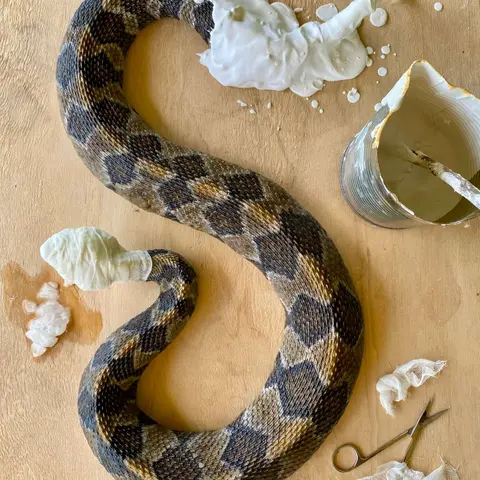
[00:08:17] George Dante: So if we're on an expedition and we can have Walter there doing his research [if I were there as the taxidermist] and we're going to talk about this at different stations, what my role in this would be, I would be looking for some of these specimens to prepare for exhibit, so I have been really interested lately in historic reptile models. Sometimes, we would actually use the real skin like we do in traditional taxidermy, but many of the reptiles and amphibians you see in museums today are actually models. They're artificial. They're molded, cast, and then hand-painted by the artist, and I always wondered why a lot of the older models in museums were more accurate than the ones we produce today. Today, we would try to salvage a specimen. We're not going to go out and kill it. We would salvage a specimen. We would get that specimen, prop it up, mold it, and cast it, but they never really quite looked as well as the older ones, and through our old journals and research and everything, traditionally snakes were collected in the field. They were taken. They were placed on the board. They would place a little cotton—absorbent cotton—around their head and put some drops of chloroform, and they would anesthetize that snake. They would then take a little melted paraffin wax and then seal in the cotton, seal in the chloroform, anesthetize that snake, pose it, and then quickly start building a plaster mold of that snake, so the molds were made when the snake was alive. It was a fast process, and there were instances where the taxidermist was almost bitten by these snakes if they were casting, you know, venomous snakes, and it was a crazy process, and there's photographs of this where after the mold was made, this snake would wriggle out of the mold, actually come right out of the mold, and be fine, so that's why we have these very accurate molds, and that is another reason why we have become so adamant about preserving older models. A lot of times these are, you know, under pressure for being renovated and restored and discarded, and they are, and, you know, we say, "No, this is such a historic process that we need to save these regardless of their condition because this will never be done again," so when we look at these old models in museums, you know, look at them a little differently now and realize that these really need to be archived and protected because this process will never be duplicated.
[00:10:57] Brett Barry: Saying goodbye to Dr. Meshaka and his assortment of reptiles and amphibians, we climbed back into our off-road vehicles and continued deeper into the property, where we encountered two diorama artists painting an expansive wetland scene en plein air.
[00:11:18] George Dante: So everyone, I'd like to introduce you to the grand exalted, the one and only Stephen C. Quinn, and, of course, Mr. Sean Murtha, who are two incredibly talented people. Tell them a little bit about yourselves.
[00:11:34] Stephen Quinn: My name's Steve Quinn, and I'm retired now after 40 years at the American Museum of Natural History. They were threatening to put me on exhibit with the dinosaurs, so I got out of there while I could, but over those years, I kind of focused and specialized on the natural history dioramas at the museum. You know, dioramas, natural history dioramas, are this unique blend of science and art. The name "diorama" actually was coined by Daguerre, who is better known as the father of modern photography and the daguerreotype, but the word has its origin in Greek, "dia," through, and "horama," to see, and it's thought, if you see it here, this is a typical alcove case. It's referring to the fact that you look through this proscenium, a theater-like proscenium, which shields your eyes to the peripheral vanishing points, and the painting is plotted on this curve, and we have some drawings up by Sean's canvas, which demonstrates how we compensate for the distortion that occurs on the curve, so a lot of the techniques that we use a grid to transfer, you know, what Sean's painting would be done onto the full-size curve, but what I'm doing here is if you can imagine yourselves on expedition with us, Sean and I would work closely together. I would serve as the foreground artist, and I would be building a little scale model, of course, in concert with our curators. You're meeting our curators throughout the day. They drive the project. They're the science behind the project. We would work with them, and let's say we're developing a white-tailed deer exhibit back at the museum. We would sit down with them, Sean and I, and look over the scene and discuss composition. Does it really give us artistically what we need in the scene distance and the sense of vista but also meet the criteria of the scientist as the typical habitat for the animal that we're depicting? Then I would go ahead and recreate a little diorama, small scale, in the field using—I have some collected twigs and things that will suggest the plants and growth that we see out in front of us and that will tell the team what to collect, what plants we want to go after, soil samples, rocks, and all the details that we would then build into the diorama back at the museum. Sean, would you like to chime in?
[00:14:28] Sean Murtha: Sure, my name is Sean Murtha. Steve Quinn hired me in 1995, and I remember saying it at the interview. Steve asked me, "What would I most want to do?" And I didn't really know what the job entailed. All I knew is that I loved dioramas, so I said, "I would love to make dioramas," and Steve kind of smiled and laughed, probably a little tear in his eye, and said, "We don't really do that anymore," and it just happened to be just a year or two before we embarked on some ambitious projects doing dioramas, so I got in there just in time. I worked there for about 11 years, and then I moved on just basically to just be closer to home and have more time to do my own art, and I work in a museum still in Greenwich, Connecticut, called The Bruce Museum. I've done some work there involving dioramas, but a lot of other things too. "Preparator" is my title, and that's kind of a catch-all phrase for anything that goes on in building exhibits. Dioramas are a special thing. There's nowhere you can really learn how to do it except here, maybe here. The normal way to transfer a small painting to a larger painting is to grid it, to make a bunch of little squares, and let's say they're an inch square, and then they're a foot square on the wall, and you just transfer everything to that.
[00:15:46] Brett Barry: Sean went on to explain some of the math involved in scaling small field models into full-size museum dioramas. It's complicated. What surprised me most, though, is that dioramas begin in the field at all [that a team of artists and scientists actually capture a place in paint and in foreground elements on-site]. Simply snapping some photos and using those as reference back at the museum wouldn't result in the same realism that comes from taking in a scene on location.
[00:16:19] Sean Murtha: If you were to flatten out, it wouldn't look like a grid. It would kind of look like this distorted fisheye kind of thing, but when you put it on the wall and you stand in front of it, it looks like a grid that goes off in all directions and that counteracts the feeling that this painting is wrapping around you. It feels like it opens up rather than...
[00:16:37] Stephen Quinn: So in the curved areas, let's say your diorama is built in the corner of an architectural space, and it bends in. You'll see that on the sides, and this is apparent in some of the dioramas. The scene almost appears stretched and made out of rubber, you know, like in the bison diorama at the museum. If you strain and look to either side, the animals that are parading off in the distance, or actually if you get inside the diorama and look at them, they're all stretched and distorted so that they look correct by the time you're outside the diorama.
[00:17:16] Brett Barry: Leaving Stephen and Sean to their artistry in the field, we headed back to the pavilion where Joyce Cloughly illustrated techniques in molding and casting leaves for museum dioramas and exhibits. Museum professionals don't just head down to Michaels for artificial trees and shrubs. They handcraft each leaf, and there are thousands of them based on species, seasons, natural imperfections, and caterpillar nibbles. George explained what's lost when time-tested techniques and artistry give way to quicker, cheaper shortcuts.
[00:17:55] Joyce Cloughly: Polish it off with a little bit of sandpaper.
[00:17:58] George Dante: This is a perfect example of why some of these older models are so accurate: because people were field naturalists. They went into the field. They did this, so imagine, and I'm going to tell you, you know, it's going to sound crazy, but it's the truth. Imagine, you know, Joyce in the field sitting there and making these color swatches fast-forward to today, where you have a 20-something-year-old in a huge exhibit-building studio that's pulling up Google Images. You know, I have never seen this plant. It's not allowed to go into the field to look at it and this and that, and someone says, "We got to make this." What kind of accuracy are you going to see in that diorama that's built today versus that diorama that was built in, you know, the heyday of doing this? You know, some exhibits I've walked past, I'm like, "Wow, you know, this was done by an artist that'd never seen this thing—never," so it's kind of sad, which, again, really helps us want to promote the relevance of this art form, but also why it's so important to save these historic dioramas—why they're so important because they may never be replicated again. There's new museums creating new exhibits and everything, but the quality shift has definitely been disturbing.
[00:19:15] Joyce Cloughly: Yeah, and they fall short most frequently with the plants. You know, it's something that they bought online from Amazon, and yeah, it's almost an afterthought, or it's not the correct species, or it's a generic fern, and, you know, of course, there's no such thing. Everything is specific, so...
[00:19:36] George Dante: If you think about it, it's like it's a crime on us because we're going there to see this. These exhibits are supposed to be teaching tools, so why would you want to go there to see an exhibit on a specific area, a specific ecosystem, and then it has a fern in there that somebody bought at Michaels? You know, it shouldn't be. We've come so far in technology in our processes, but yet the way we do things has gone in the other direction, you know, and this is something that, you know, we take a hard stand against alone, but we do. Yes, but no, this is so important.
[00:20:15] Joyce Cloughly: Yeah, well, get out into the real world. Please, just get out into the real world.
[00:20:19] George Dante: Yeah.
[00:20:20] Brett Barry: Before heading back into the field, we had some time for lunch, and I got to catch up with my driver, George Dante, Sr.
[00:20:28] George Dante, Sr.: Yes, I'm George Dante, Sr., George Jr.'s father, and I've been helping him along and set up these field stations, you know.
[00:20:40] Brett Barry: What's the history of this property?
[00:20:42] George Dante, Sr.: This piece we only owned for about 4 years. We originally bought the 170 acres down the road where the house is, where the other small cabins are, in 1983, so we're here, up here, over 40 years. We bought it mainly for recreation.
[00:21:00] Brett Barry: How did George get into taxidermy? Was that an interest of his as a young person?
[00:21:06] George Dante, Sr.: He was 6 years old, I believe, and he just loved animals and nature. You know, he was always in the backyard looking for things, and I bought him a fish in the supermarket that he skinned out and mounted. I believe that was his first thing, and from there it just blossomed into what he does. You know, he's got a deep passion for it, and then he took a big interest in the museum work, and just started wanting to preserve it, and that's when we bought this piece of property, like I said, about four years ago, and a year later we put this building up, and he furnished it to look like an old museum studio. You know, how they would do their work and put things together.
[00:21:51] Brett Barry: And how do you enjoy working with him in this new endeavor?
[00:21:55] George Dante, Sr.: Well, like any father, you know, you're proud to see your son succeed in what he likes. His ambition, you know, I mean, I know nothing about it. I don't do any taxidermy or anything like that. I just help him build things. You know, when he needs stands or models, I help him with that, but that's about it. I don't do no skinning, no stuffing, no animals...
[00:22:18] Brett Barry: Mr. Dante then offered me half of his sandwich, a gesture I would soon recognize as characteristic of the Dante family generosity. Here's George Jr.'s wife, Heidi, with more.
[00:22:30] Heidi Hornstein: My name is Heidi Hornstein. I'm George Dante's wife, and I'm thrilled to be here as part of field days this year.
[00:22:37] Brett Barry: And you are also very much involved with this organization. Can you tell me about it and how it came to be?
[00:22:42] Heidi Hornstein: Sure, I mean, this is my husband's brainchild, and I am not part of the museum community. I am—I work in healthcare, so it's a completely different realm for me, but I'm thrilled to help out and learn more about natural history and museum exhibits and everything, so I'm functioning as a secretary, trying to put together those pamphlets and literature for the institute right now.
[00:23:06] Brett Barry: But from your perspective, tell me a little bit about George, his passion for what he does, and his expertise and how that's developed into wanting to, you know, teach about that and have people appreciate traditional methods.
[00:23:20] Heidi Hornstein: Sure, so George just radiates enthusiasm for this subject, and it's nothing about—this is made up or pretend or anything. He literally is so passionate about natural history, about preserving collections, and about the history of natural history, so he just is so crazy about educating people, bringing them in to learn about this and keep it going, so he's terrified of those who are, you know, retiring and we're losing the knowledge of their skills, and he just wants to be the one that helps document it, record it, and preserve it for eternity so everyone will be able to learn about those methods that it won't be lost.
[00:24:03] Brett Barry: And we're standing by a large rhino of some kind, and what do the neighbors think about what's going on here, or do they kind of scratch their heads?
[00:24:11] Heidi Hornstein: No, they are just—they're blown away. I mean, every single one of them, when they come visit us, they grab their family and friends to come and look. They're like, "You have to stop here," so we love that. It's like little mini tours that we are able to give the neighbors. We're excited for them to learn more.
[00:24:28] Brett Barry: With a full schedule and no time to spare, our drivers started up the UTVs, and we jumped back in for a ride to the next field station, a rustic ornithologist's cabin, where Dr. Peter Capainolo, senior museum specialist in the Department of Ornithology at the American Museum of Natural History, had an eviscerated ruffed grouse in hand, and this... so close to my turkey sandwich.
[00:24:56] Peter Capainolo: A little something about me: I've liked birds my whole life. It's never been much different. I've been interested in birds, live or dead, and museums, of course, were a great place to go and look at birds in dioramas. You know, today is sort of the day of the diorama. We're learning about how they're produced. While collecting specimens for general research or any sort of specific kind of project that someone may have, either in the old days or right up till today, you know, the goal is to collect a nice series of specimens [whether it's reptiles or fish or mammals or birds] so you have a nice reference series from different areas. Now, usually birds, when we produce a specimen in the field, we make something called "a study skin," and that's very different than a life mount. You know, you're used to looking at a diorama and seeing birds in a diorama with glass eyes, and their wings are wired so they look like they're flying. They look like they're alive in the environment, so a life mount. Behind-the-scenes, there are tens of thousands, millions of study skins that researchers use to study ecology and evolution [all kinds of bird biology]. It may be that a specimen is needed for a life mount in a diorama, in which case maybe you don't make a study skin. Maybe you get it back to the museum frozen or something so the taxidermist can life mount it for the diorama, but even if it's a study skin, there's all kinds of information in the skin. You've got size information, you've got color information, the morphology of the bird, and so on, so somebody like Steve or Sean could take a study skin, and if they're painting a bird in the habitat, you know, you've got all the colors here, you've got the shape and all that kind of stuff, and folks like that are real good at taking a study skin, which is just sort of a round skin full of cotton. It doesn't really look alive. It just looks stuffed [and making their portrait look very much alive based on the skin], so what I've got here is a specimen of a ruffed grouse. It's a common bird in the biological field station. I skinned it out a couple of hours ago, and I didn't finish it up so that you could see sort of the process, so basically what I've done is I've taken the skin off the bird. The feathers are attached to the skin. It's sort of like a pelt, any kind of animal pelt. I've pulled out the carcass, which is sitting there on the barrel, and I've started to stuff up the head. You'll see the cotton eyes in there, and I've put an artificial cotton skull in there because its skull was a little damaged, so I had to make him a new skull or make her a new skull. Turned out to be a female, and you can do that with a grouse-sized bird. You could do it with an ostrich. You can do it with a hummingbird. This is what museum and field ornithologists do. They basically make study skins. Another specimen type is a skeleton, and you may have gone into a natural history museum and seen a nice avian skeleton articulated, nice and clean and all of that, but somebody had to put that together, and it had to start out as just a dead bird. The way we prepare a skeleton for skeletal material, either for display or for research, is you start with a dead bird, so the field ornithologist would take that whole bird, take a look at all of the coloration, look at the plumage characteristics, and write all this stuff down. It's very important to take notes on everything that's going on because you don't want to lose anything, and before you got here, I was working on this screech owl going to turn that into a skeleton. Well, actually, it is a skeleton. I'm not going to turn it into one. It's going to become a specimen for display or research, and this is one of these gray-phase screech owls. You can't tell that it had gray feathers, though, right? Because they're not there anymore, so in my notebook, of course, screech owl, you know, gray-phase, molt, all these kinds of things, and all I've done is taken off some of the large muscles, the skeletal muscle, and I've eviscerated the bird. You can see there's a hole through the body there, and that's good, too, so that the air circulates through because we want them to dry. This one's still a little bit juicy because it's new. I looked—oh, a couple of hours. Yeah, well, the specimen was salvaged. Someone found it, so it was frozen, and I just did it this morning. You know, it's kind of neat because you think of an owl as this big puffy bird, right, and then you take the feathers off, and it's like, you know, wah-wah-wah, right? Now, what are we going to do next? You know, how are we going to get these, the bones, nice and clean? Back in the old days, we would just macerate the bird. You could do that and then put it in water and let it decompose, and then somebody would have to come along and sort of scrape out the rotting flesh and so on. Much more recently, we used something called "dermestid beetles," and the larval forms of those beetles are carnivorous, and so most major museums and some private individuals have these dermestid beetle colonies, and you take your little dried birds, and you put them in there, or your dried mammals, or your dried fish, or your dried—it doesn't matter, and these beetles will eat pretty much all of that remaining flesh off of the bones and leave a nice disarticulated pile of clean bones, and then they stay that way, and they go into the research collection, but somebody like George or Steve or one of the people who are producing displays [they might need a skeleton of a screech owl], and so we give it to them, and they can rearticulate it so that you can see how it all works together.
[00:30:43] George Dante: People are really intrigued by the process, and we hope to launch a whole series of these expedition experience classes because not only will you get kind of what you're getting today, but you'll get it more in-depth, and you'll get an opportunity to come here and work on these yourself, so we do a lot of hands-on work. So, for example, we tell you about the history and the material and the processes, and then you'll actually make your own study skin, and you'll make one that you could actually take home because we'll use invasive species and things like that that we've gotten from different sources, so you'll get to make a study skin, and you'll get to make a wet specimen or an alcohol/spirited specimen. They call them various names. You'll get to make one of these skeletal prep pieces. You'll get to blow eggs to make an egg collection because, like Peter said with ornithology, you had all these different specimen types.
[00:31:36] Peter Capainolo: And these specimens have become more information-rich over the years. In addition to all these careful notes we have now, and being able to digitize the data and all of that sort of stuff, there's a lot of DNA work going on. Everybody's looking at DNA. This is just a little tissue tube, and I've taken some of the skeletal muscle from that screech owl that I prepared, and macerated it a little bit, and just put it in this tube of ethanol. It's got the field number and my number on it, and this'll go to a major cryo lab for storage. Most major museums now have these cryo labs because everyone's doing gene sequences.
[00:32:20] George Dante: Aside from the scientific value, there's the art value in all of this. As flat artists, as sculptors, you know, there's our information, there's our data that we want, and today it's increasingly difficult to access these because the museums are not going to let you behind-the-scenes. It's become very difficult, so through our organization, we're trying to—we have state and federal permits to salvage specimens and, you know, window strikes, things like that, and we're taking them, and Peter is also our curator of birds for the institute, and we're building a whole teaching collection because our goal is to keep building a massive collection like this, so if you're an artist or a researcher, we're giving you access. Do you want to come and look at bird color? Come to our collection and access it, so that's one of the things Pete's been working on [is really kind of building the institute's collection of skins and wet specimens and skeletal pieces].
[00:33:20] Brett Barry: Peter went on to illustrate traditional methods for collecting birds [nets, traps, guns], and then we left him in peace so he could finish prepping that grouse, and we were off to the final field station, where we found Smithsonian mammalogist Darrin Lunde sitting on the porch skinning a squirrel. Throughout his career, Darrin has collected thousands of museum specimens and has discovered and described a dozen new mammals.
[00:33:53] George Dante: Darrin, we were talking to Peter about, you know, why do we still need collections, and why do we need to continue this work? So what's your take on it? Why do we not have enough? Why do we need to continue with this?
[00:34:05] Darrin Lunde: So you can think of a specimen as a data point, right, and the more data that you have, the more you can understand patterns, and I like to think of specimens as a time and a place, okay? So in our mammal collection at the Smithsonian, we have more than half a million mammal specimens in the collection, and it's like—it's a common misconception that it's like—it's not a postage stamp collection. It's not like we want just examples, you know, to show like, "Here's my complete set of mammals." Those are data points. They are data points with time, and so we have specimens from every year going back more than 200 years, and you could look at specimens of the same species from the same place, and you could document change with time. You could document how distributions have changed [how invasive species have moved into habitats where they didn't exist before], and we could show patterns across geography, which is really, really what evolution is: how things respond to their environment and different sorts of events that isolate them genetically and cause them to speciate. You know, really, the value of a museum collection is that you can look at virtually any species from any geographic location and find examples and compare them all at the same time. You would never be able to do that by going out with binoculars and trying to make notations on the color of birds or mammals, and so we still need these today because, you know, like, a big part of the work that I do today is it's not just collecting mammals. I mean, we're interested in documenting diversity, but we also have to diversify our program, and so a lot of what we're doing is working with, like, the Centers for Disease Control or the National Institute of Health and getting money and doing other things. We're working with different organizations that—it's our project in Uganda, which is looking at bat diversity, but it's also looking at bat diversity with another side that's looking at the immunology of bats and why they have such crazy immune systems and why they're able to be carriers of so many diseases and not get sick themself, and so we're collecting these tissue samples in these tubes, and we're, you know, there are biomedical implications. There are all kinds of, I mean, look, it was just a few years ago that a virus that is essentially, it's a bat virus that jumped over into humans. It basically shut down everything. COVID-19 came out of a bat, and the diversity of species within the major groups is not well known, and you can't understand the ecology of a virus that's impacting human health if you think you're working with one species that is actually a whole complex of five or six species, maybe, and the only way we're going to piece that apart is by continuing to collect specimens, not just skins and skulls and skeletons, but molecular data as well. That's going to help us get that foundational information about biodiversity so that we could then ask these bigger questions about things that are important. It's also important to conservation. You have to know what you're saving before you could effectively, you know, develop a management plan.
[00:37:34] George Dante: Tell us about some of the conditions that you've had to work in and things like that, you know, just to speak into this fieldwork and that it's, you know, not cut out for everyone and the amount of effort it takes to get these specimens back.
[00:37:49] Darrin Lunde: You know, I've worked a lot of places. It adds up to, like, actual years of my life spent, like, living in the forest for weeks and months at a time. It sounds like fun. You know, you're camping, you're living outside, and you're often working in very remote areas, very dangerous areas. You know, typically, I'll get in a locality, and I'll stay there for weeks. It's not about climbing a mountain and getting a nice view, and it's dirty work. You know, it's bloody. You're working with chemicals. You know, nowadays, a lot of the work we do is we set up, like, under a tarp like that, and it's like a little mini lab with liquid nitrogen tanks and with tubes, and we're just sitting there one after the other just cutting little bits of tissue and putting it in, and it's—you've got a dozen animals. It's just meticulous work, which, again, I say you can't ever take a break [because you're dealing with things that are drying out], and you're dealing with things that are rotting. You're dealing with traps that need to be rebated because if you don't rebate them, you're not going to get animals the next day, and you get the thing rolling, and it just keeps rolling, and at the end of it, a typical expedition, you'll have, you know, a few hundred specimens, maybe, of small mammals, one or two hundred, maybe, depending on how long you're out, but they're all hard-earned.
[00:39:06] Brett Barry: I learned more about Darrin's research at dinner that evening, where we sat side by side, and he told me about his ongoing Ebola field research in Uganda, wondering if I should have switched seats. We also discussed his book, "The Naturalist," a biography of Teddy Roosevelt that I just so happened to be in the middle of reading. The caliber of Darrin's work and of everyone who spoke that day gave me a real appreciation for being in the company of people at the top of their fields, and it turns out I wasn't alone in that thinking. I checked in with fellow expeditioner Vanessa Hoheb, an artist who specializes in molding and casting.
[00:39:50] Vanessa Hoheb: I knew it was going to be terrific, but I really—I'm trying to find the words to describe today. It was so beyond what I imagined in terms of excellence. I'm really just barely processing it now, and I'm really glad I brought my phone charger because I took so many pictures. I would've been bereft if I hadn't been able to do that. The work that George and his family are doing is so important, and to carry on the traditions of craft, craftsmanship, artisanship, and materials handling and to pass it down to the future generations is vital to our existence as a culture.
[00:40:34] Brett Barry: And the assemblage of people who are at the top of their craft, all being here, all being able to be here at the same time, was pretty incredible.
[00:40:45] Vanessa Hoheb: I read the bios of all of the instructors of the presenters today, and I was just stunned by the level of expertise, and as you just said, to have everyone here at the same place at the same time is a cosmic lining up of stars.
[00:41:05] Brant MacDuff: My name is Brant MacDuff. I study wildlife conservation strategy and economics, and I wrote a book called "The Shotgun Conservationist: Why Environmentalists Should Love Hunting."
[00:41:19] Brett Barry: How were you introduced to this field campus out here in Andes?
[00:41:23] Brant MacDuff: I know George Dante through the taxidermy world, which is very small and full of adorable freaks and weirdos, and so we all know each other. This place is very magical to people who are museum nerds, and as soon as he put together the field day, I knew I definitely wanted to be a part of it and see what he was doing out here because public education is as much a part of museum work as anything else, so I'm glad that he's created a way to share what dioramas are and what museums are with people so they can get a real hands-on experience as opposed to just looking at an awesome diorama [really, really seeing what goes into a diorama and the field research needed for the science of museum naturalists].
[00:42:21] Brett Barry: And the people who are here, the presenters and George, are at the top of their game.
[00:42:26] Brant MacDuff: Yes, a hundred percent. This is for museum nerds. I mean, the people here who are the presenters—I mean, you're really talking about, like, the Beatles and the Rolling Stones of museum naturalists, like museum nerds. These are people who are absolutely at the top of their game in the field working today anywhere. George Dante and Stephen Quinn, like, these are the heavy hitters of the museum nerd world.
[00:42:56] Brett Barry: And right here in the Catskills, which is a happy coincidence, right?
[00:43:03] Brant MacDuff: Coincidence, maybe, but New York City, New York State, is really the birthplace of wildlife conservation for America. A lot of the wildlife conservation laws and regulations that we have in America came directly out of the American Museum of Natural History in New York City, and a lot of those naturalists either started in the Catskills or would come up to the Catskills often because it was always this escape from New York, even in the early 1900s, and so sort of the mix of all that, the taxidermists who came out of here, the early taxidermy studios, and the people who were coming down to work from the museum, it's very, very connected. Yes, the institute focuses on the history of natural history museums and museum collecting and museum preparations, and I think the more people get to see it in this close-up way, the more they can become ambassadors for these natural history collections and museums. That's a lot of the higher-ups in the museum world. They kind of think that everything should go to screens and, you know, whatever's high-tech gobbledygook, but truly when people go into these museums, the thing that captures them the most are the dioramas and these real specimens, and you don't often get to be that close to an, you know, Alaskan brown bear, and at a museum you can, and so the sort of capturing the magic and showing people it is still relevant is, for me, that's very important, and the institute really puts that to the fore.
[00:45:02] Brett Barry: Okay, we've heard from a lot of voices in this show, and if you're still with us, that's great because I've got one more interview to share with the man behind the organization that's putting all of the resources, energy, and passion into preserving the history of natural history museums.
[00:45:23] George Dante: So my name is George Dante, and I am the president and founder of the Institute for Natural History Arts.
[00:45:31] Brett Barry: Tell me a bit about your career and how this came about.
[00:45:35] George Dante: So I spent my career as a museum taxidermist, and I still run my private studio in New Jersey, and I've been spending the last several years restoring historic natural history museum exhibits, specifically historic dioramas, and I realized that there was a growing disconnect with knowledge on the people that created them and the general public, and also, even the museum staff. You know, as staff retires, you have less and less people there that kind of know about the history and how they were created, and there's less mentorship. I was mentored myself by a number of people that were these amazing, talented individuals that I felt, man, if somebody doesn't record what these people know, it's going to be gone forever. We're going to lose all of this, and at that moment I had that anxiety of how do we start preserving this, and I talked to friends and colleagues and said, "You know, we need to do something. We need to start something." Yep, so, you know, we talked about this. We said we need to kind of formally organize this history. How do we organize the history of the methods, the material, and the people? Because you had this trifecta of loss going on. We were losing the artwork. You know, if a diorama becomes irrelevant for some reason, which they don't, but a museum may think they need to renovate and try something different, then we often see them get lost. How do we prevent that? How do we prevent the loss of the processes that were used, and then how do we bring awareness to these kinds of forgotten people that created all these artists? You know, no one gets to sign a diorama. You know, we look at these things every day. Millions of people look at them, but no one gets to sign them. No one really knows, so how do we organize this? Museums do a great job. There's stuff in archives, and there's, you know, there's files and things like that, but it's not organized where you and I can get at it, you know, and you really have to know what you're looking for, so I said, "How do we remedy this problem?" So we said, "Let's start the Institute for Natural History Arts, a way that we can organize the history of historic dioramas and collections. Also, develop programs that would become almost like an outreach, where we can get people, the general public and museum professionals, both out and understand how these things are built, how it was done, kind of how we do it today, what's different, and what's changed, but mainly to honor the historic methods and really kind of help people understand, you know, how these were created," and it's been very popular with even natural history conservators, so conservators, you know, are tasked with caring for these in museums, and there's a lot of questions. What is the taxidermy made out of? You know, it changed so much through history. It evolved in the chemicals and the pesticides. What about the materials in the diorama? What's the foreground made out of? Plaster, burlap, and machés—so, you know, we were able to answer a lot of those questions for them. We wanted to bring them in and say, "Hey, you know, we know this was done and this was done, and, you know, we know about some of this stuff," and it's really just about sharing knowledge. We wanted to be basically a resource for institutions and the general public of the "how it's made"—the behind-the-scenes.
[00:49:09] Brett Barry: Incorporating techniques that would be lost to history.
[00:49:13] George Dante: Absolutely, and we're still losing them because, as the institute, we're not working fast enough. It's almost—it has an urgency now because we're losing people every year that know some of these processes and materials like no one else. It's a small population that's left that knows about using this material, how they were built, or even just some of the key historical points.
[00:49:41] Brett Barry: Tell me about this property, the Catskill Biological Field Station, yeah.
[00:49:47] George Dante: So we started the institute out of our studio in New Jersey. In New Jersey, we have an archive. We have artifacts. We have a collection. We run classes out of there. That is a place. It's a working studio. That's where you can come, and you can take classes in an environment that's still creating museum exhibits and restoring them. I've had this property in my family since I was a kid. My parents bought this property when I was 10 years old, and I fell in love with the Catskills. I love it up here, and I loved coming up here, and as I grew older, I loved it even more, and as I got married, my wife loves it here. My kids love it here. I love the community. I feel closer to this community than I do back at home in New Jersey. As I'm around this property, I'm like, "Man, wouldn't this be a cool place to do something where we can get people outside learning about natural history?" I was very much into history, especially historic expeditions, because that's another question that we always had, like, how did this material get into the museum? How did the specimens get there? I knew about, you know, foreground artists going out collecting plants, and we knew about mural artists painting on-site, but, you know, the challenges, the issues they had, the hardships, so I said, "Wouldn't it be cool to kind of teach people about that but give them this immersive experience?" Almost like a living history kind of thing, where they would come out and kind of maybe use some of these historical practices themselves in the field while creating this art themselves, and we said, "Well, we're going to need a place to teach these classes," so we put up those little cabins. We said, "Let's outfit them like little naturalist cabins. If you were a naturalist collecting in the field, you would have a base camp." Where would it be? What would it look like? What would the gear be like inside? And we started putting those around the property, and we're like, "This is great. We'll travel people around, and we'll let them take parts of the class at each of these cabins," and that's what we do. We move everybody around so they get to see the property, they get to see the cabins, and they get to work in a different location, and then I said, "Well, if we have more people, or if it rains, we need a bigger space," and that's when we thought, "Well, let's put up a larger building that'll be basically the home base here," and that's when we decided to put up this pavilion, and the pavilion is basically the workshop of an old 1900s museum. It's the workshop that encompasses everything. You have the laboratory. You have the taxidermy, the exhibit building, and the woodworking. That's a forgotten end of it, too. Most people didn't realize the museum studios at that time would build everything. They would do the cabinet work, you know, the vitrines. Everything needed to be done, and there was this wonderful population of artists that worked together in these spaces, and that's what I wanted to recreate here, and I wanted to keep it as historically accurate as I can with collecting antiques and, you know, collecting these artifacts so that people could come in and immerse themselves in that.
[00:52:55] Brett Barry: The pavilion and the historic cabins are chock-full of whatever gear and tools and implements would have been used in the early 1900s. How quickly, I mean, you must have been collecting that for years and years and years. I mean, you can't just find this stuff in that mass quantity.
[00:53:18] George Dante: I was always interested in antiques and loved collecting. I always appreciated antiques, even at a young age, and my parents loved antiques, and, you know, we've collected some stuff over the years because I love the history of tools and things like that, but once I really got into this, I started reading more about these expeditions. I started reading old taxidermy books, old expedition manuals/manuscripts, and things like that, and I said, "Wouldn't it be cool to find some of these things?" And it was intriguing to me that some of them didn't exist anymore, or they were very, very difficult to find. Then it became a hunt, and then I really became obsessed with finding these artifacts because I said, "You know what? We may be the only place where you could come and see this material. We may be the only place where you could really immerse yourself in something like this," so then it just fueled the passion for finding these artifacts.
[00:54:22] Brett Barry: So as you're concluding the inaugural field expedition day here on the property, how did it go in your mind? Is it what you expected? What have you learned from the experience, and do you think that this will continue?
[00:54:39] George Dante: My head is spinning. I am just glowing with excitement from this day, and it went better than I anticipated, and I loved just feeding off of everyone's excitement and energy, and I think that could be said for our participants, our presenters, and what I love about all of our classes, and especially this, is there is such a community of like-minded individuals who love natural history, love dioramas, and love historic exhibits, and we're out there, and this is a way to bring our community together. This is a way to kind of gather ourselves so we could enjoy each other's company, learn from one another, and really just kind of immerse ourselves in what we love.
[00:55:27] Brett Barry: What's on the agenda for the future? I know that this is still a very nascent experience, but what else are you planning?
[00:55:35] George Dante: One of the most important projects we need to start looking at is oral histories. I mean, you yourself today saw that, you know, there's an urgency with recording the stories of these people, and that's something we're looking at. We're looking to try to see if we can raise funding to try to really put together a comprehensive project to start recording all of these individuals. We have so much to do, and it's difficult to do it with a limited staff, and, you know, that's all volunteer, and it's a time-sensitive issue, so we also are working as fast as we can, trying to do as much as we can, but we need the help. We need the support. We need the help.
[00:56:16] Brett Barry: Well, this has been incredible. I knew it was going to be special, and it was very much so, and it's evident how much work and passion has gone into this place and this organization and what you're passing down.
[00:56:29] George Dante: I love that, and I'm so happy to have you here, Brett, and we love this, and all we want to do is spread the love. All we want to do is get people interested in this, and so you go to natural history museums. You go back to the ones you love. You look at those dioramas, and, you know, we just keep passing down that passion and get out and enjoy the beautiful Catskills. How could you not love this area? It's just fantastic, so I couldn't dream of doing this anywhere else.
[00:57:02] Audio: [SONG: "Folsom Prison Blues"]
[00:57:04] Brett Barry: As dusk settled over the field station, the day ended not with lectures or demonstrations, but with music: guitars, a fiddle, and a circle of museum scientists, artists, and enthusiasts singing together after a long day in the field. It felt like the perfect closing note to a place devoted to both precision and wonder. If this world intrigues you, take a look at naturalhistoryarts.org. The Institute for Natural History Arts is doing something uniquely special and real here in the Catskills, preserving the traditions of natural history while inviting the next generation to step in, learn, and take part. "Kaatscast" is a production of Silver Hollow Audio. Production Intern: Elana Healy, Transcriptionist: Jerome Kazlauskas, and I'm Brett Barry. Stay in touch at kaatscast.com. Thanks for tuning in, and we'll see you next time.
[00:58:04] Audio: [MUSIC ENDS]


