Gunpowder, Greywacke, and Gin at Skillers Mountaintop Distillery
Key Takeaways
- Skillers Mountaintop Distillery in Lexington, NY, was founded by James Rooney after he transitioned from a career in tech during the COVID-19 pandemic.
- New York's favorable craft beverage legislation, including the Farm Distillery Act, allows small producers to operate tasting rooms and sell direct-to-consumer while supporting local agriculture.
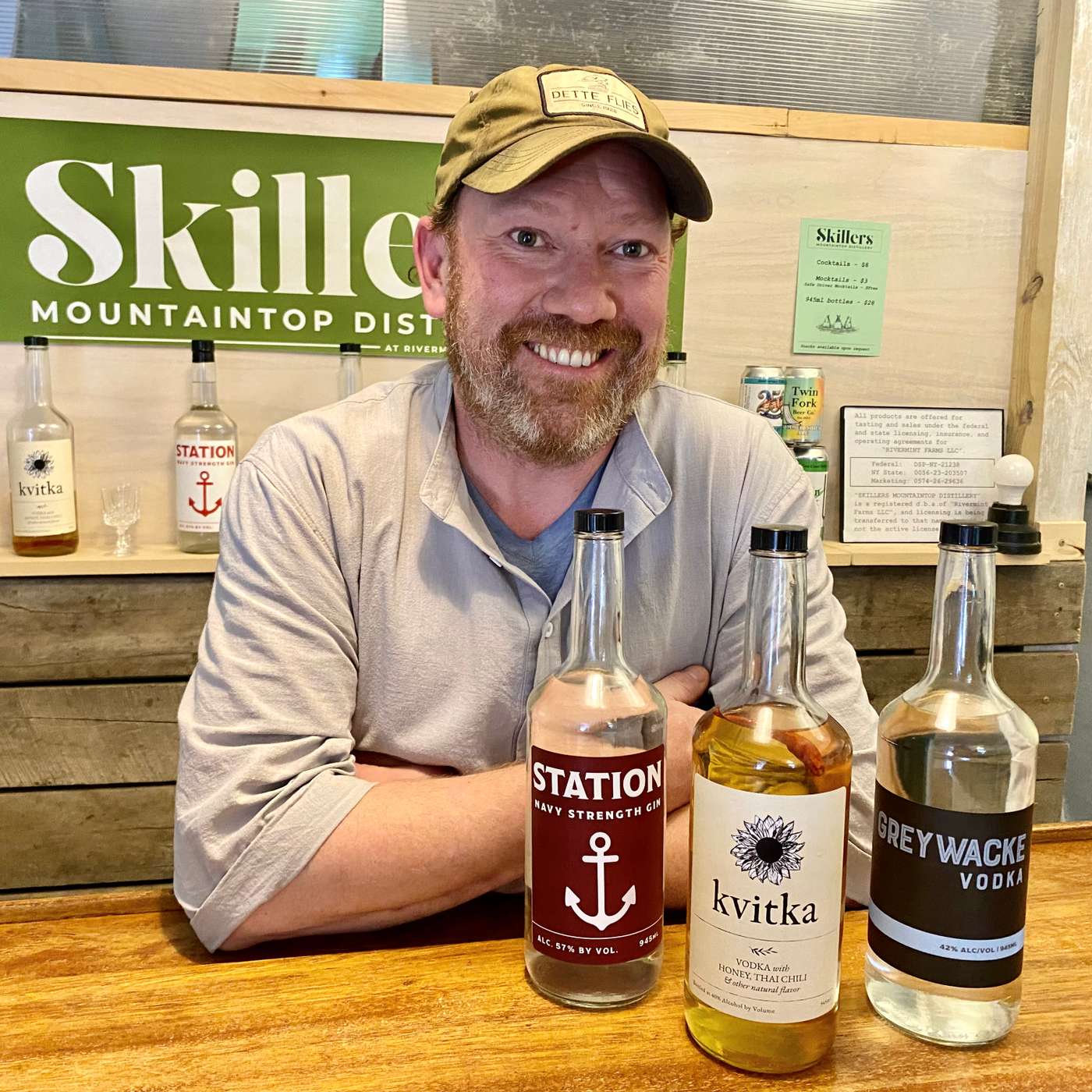
- The distillery's three core spirits—Greywacke vodka, Station Navy-Strength Gin, and Kvitka horilka—utilize 100% New York State corn as their base.
- Greywacke vodka gets its distinct mineral edge from local Schoharie Creek water filtered through millions of years of regional bluestone bedrock.
- Station Navy-Strength Gin is bottled at 57% ABV specifically to maintain its structural integrity and bold profile when mixed into classic cocktails like a Negroni.
- In addition to tastings, Skillers hosts a popular weekend acoustic music series and offers a dedicated selection of non-alcoholic craft beverages.
At a Fleischmanns street fair, a bottle with a bright red label and bold white type — Station Navy Strength Gin — stops Brett at the Skillers booth. Owner James Rooney pours a taste and explains why British sailors once needed their gin strong enough that gunpowder would still ignite if it got splashed with the stuff. That bottle leads to a drive up to Lexington, NY, to see where it's made.
Skillers Mountaintop Distillery occupies a small pre-fab barn in what started as Rooney's ski house property near Hunter. Kaatscast walks us through some of the New York state laws that made a small operation like his possible — the Micro Distillery Act of 2003, which cut licensing fees enough to let small producers in; the Farm Distillery Act of 2007, which let distillers open tasting rooms and sell direct, the way wineries already could; and the Craft New York Act of 2014, which simplified licensing further and let farm distilleries sell in satellite locations. In exchange, farm distilleries have to source at least 75% of their ingredients from New York — Skillers uses 100% New York corn as the base for all three of its spirits, filling in the small remainder with botanicals like coriander that can't be grown locally.
The three bottles get a full tasting. Greywacke vodka takes its name from the bluestone bedrock under the Catskills, and Rooney credits its stony, mineral edge to Schoharie Creek water that's filtered through that rock. The navy strength gin, bottled at 57% ABV, is built specifically to survive being mixed into a Negroni without landing flat. And horilka — a honey and chili spirit named for the Ukrainian word for flower (kvitka) — nods to the area's Ukrainian community, using local honey and an ultrasonic extraction process to pull flavor from Thai chilies.
Gin-smith Jeff Graham describes running the still, watching a batch drip for hours to yield about 20 gallons at a time. Marketing director Todd Spire talks about the tasting room's weekend acoustic music series. And we learn that Skillers spirits are now on shelves at Elevated Wines in Hunter and behind the bar at Small Talk in Woodstock and Peekamoose in Big Indian. Next up: a Skillers Negroni made entirely in-house, which means Rooney is now considering his own line of vermouth.
Featuring
- James Rooney, founder and owner, Skillers Mountaintop Distillery
- Jeff Graham, gin smith
- Todd Spire, director of marketing
- Ric Rawlins, tasting guest
Music: "Growing Up Catskills" by Josh Roy Brown, from the documentary of the same name.
Frequently Asked Questions
Where is Skillers Mountaintop Distillery located?
Skillers Mountaintop Distillery is located in Lexington, New York, situated Hunter Mountain ski area.
What are the ingredients in Skillers Greywacke vodka?
Greywacke vodka is made using a 100% New York State corn base combined with local water from Schoharie Creek that is naturally filtered through the Catskills' native bluestone bedrock.
Why is Skillers Station Navy-Strength Gin bottled at 57% ABV?
It is bottled at 57% ABV—the historical strength required for gunpowder to still ignite if splashed by gin on British Navy ships—so that the spirit's bold flavor does not get washed out when mixed into cocktails.
What is Kvitka horilka?
Kvitka is a Ukrainian-style horilka made with local Catskills honey and Thai chilies, which are extracted using an ultrasonic process to pull out floral notes and heat without cooking the ingredients.
Transcription by Jerome Kazlauskas
[00:00:00] James Rooney: The British Navy used to store their gin in casks above the gunpowder, and they would leak, but the gunpowder would still go bang if it was 57% or more. Also, the sailors would put it with gunpowder and light it on fire to make sure that it went bang, which meant that it proved that it was the 57% that they were supposed to get, and no one was watering down their ration.
[00:00:20] Brett Barry: A couple of months ago, on a gray Memorial Day weekend, I passed a local distillery booth at a Fleischmanns street fair and was stopped by a bottle that practically shouted from the table: a bright red label, a white anchor, and bold type that read, "Station Navy-Strength Gin." Owner James Rooney poured me a taste and offered a quick history lesson: how sailors once carried gin at a proof strong enough that gunpowder would still catch fire if it got splashed with the stuff. Plus, it makes a terrific Negroni. I'm Brett Barry, and this is "Kaatscast: The Catskills Podcast." James Rooney's Station Gin is just one chapter in the story of Skillers, so I took a drive up to the distillery in Lexington, New York, to hear the rest.
[00:01:13] James Rooney: I am James Rooney. I'm the founder and owner of Skillers Mountaintop Distillery here in Lexington, New York. I came up here. This was really meant as a vacation ski house. We're really close to Hunter Mountain, Windham Mountain, and Belleayre is right down the road, and I bought this little ski house to be able to come up in the winter, certainly for skiing, and in the summer to enjoy the river that's right outside what's now become the distillery.
[00:01:35] Brett Barry: Where did you learn how to do this? Did you have a background in distilling, or is this something fresh?
[00:01:40] James Rooney: In that I have any background in such things at all, it's in cooking. I'm sort of an aggressive home cook, and I've worked in restaurants and bars throughout my life. Before, I went into the tech industry in New York for about 20 years, and then I came up here. I bought this house in late 2019, and I came up with working on some of the plumbing and electrical systems. It was, as a lot of houses are here. It needed some love. In March, I came up with a backpack and some plumbing equipment, and my office closed for a flu that was going around, which turned into COVID, and I've been here ever since.
[00:02:10] Brett Barry: And so is this full-time?
[00:02:12] James Rooney: So this is full-time for me now. I was doing consulting remotely for some tech companies, but this really takes a lot of your attention, and trying to manage both, I felt like I wasn't doing a very good job on either, and this is way more interesting. I really wanted to get into making something with my hands after 20 years of pushing pixels around for advertising companies. I really wanted to get into this, and it became really clear it was an all-or-nothing pursuit, so I had to decide, and I went for all, and that's where we are now, so I really wanted to get out of that tech environment and into, you know, craft and doing something real, and I started looking around, and New York has the Craft Beverage Act, and it makes it really attractive to become a craft brewery or distillery, winery, or cidery, which is where a lot of the places that have popped up in the Catskills are taking advantage of the act. They give you a lot of help on the legal requirements and lowering like the bond requirements and other things to make it where if you don't have a million dollars to throw at it, you can still open it and run successfully and legally. We have a lot of those around here.
[00:03:08] Brett Barry: The Craft New York Act that James is referring to was signed into law by Governor Andrew Cuomo in 2014. Farm distilleries were allowed to open satellite tasting rooms and retail shops away from their production site. Licensing was simplified for producers who operated multiple types of facilities, say a brewery and a distillery under one roof, and it opened new sales channels and made it easier for small distillers to reach customers far and wide. A decade earlier, in 2003, New York passed the Microdistillery Act, slashing the annual distillery licensing fee from $50,000 to $1,200, opening up distilling on a much smaller scale. Another big change came in 2007 with the Farm Distillery Act, allowing producers to offer tastings, sell bottles directly to visitors, and operate tasting rooms—privileges that had long been available to wineries but not distillers. In exchange, New York State farm distilleries, like Skillers, must use at least 75% New York-grown ingredients.
[00:04:20] James Rooney: So we do that by using 100% New York State corn-based alcohol in all three of the spirits that we have out now. The whole idea and the reason that it's called a Farm Distillery Act is that it's to support farms, so we're not on a farm right now. You don't have to be on a farm. It explicitly says that. In fact, there's a farm brewery in Brooklyn on Carroll Street, which is very much not on a farm. It's called the Farm Act because we're supporting New York State agriculture. We do 100% because that's what we're here to do.
[00:04:45] Brett Barry: And by using 100% of a New York-grown base grain, there's plenty of headroom to bring in some imported botanicals.
[00:04:53] James Rooney: Think of the spices in a gin, for instance, like there's not a lot of coriander that we can source in New York, so we do have to bring that in, but it's a very small percent of the total, so we're still in that, like, 95% plus, almost 99% plus for the total amount in each bottle.
[00:05:07] Brett Barry: How do you retain the flavor of the ingredients in a process that's engineered to purify whatever you're feeding the still, right? It's a process of evaporation and condensation and, well, distillation, which I would imagine takes a lot of that flavor away. How do you put your mark on a bottle?
[00:05:25] James Rooney: Yeah, it's very interesting, and it's a good question because it is unintuitive. It comes down partly to what you're making, so, for instance, if you're making vodka, which is generally, yes, a process of filtering, distilling, taking out flavors, taking out bad alcohols, fusel alcohols, heads, tails, and the things that you don't want to really get the pure hearts, the good-tasting and very clean part, then that is exactly like you're describing, but alcohol's also a very good solvent, so in the case of gin, where we can put the botanicals in the barrel, the alcohol vapors are going to do that job for us so that we're going to take those vapors out, which is the distilling, then they're going to go through, gather up those flavors, and drop them off in the distillate so the oils can carry through with the alcohol because alcohol and oil are friends in a way that water and oil aren't.
[00:06:08] Brett Barry: Speaking of gin, those sounds in the background are all courtesy of Jeff Graham, the distillery's budding ginsmith.
[00:06:16] James Rooney: This is my neighbor Jeff Graham. He became very interested in this process, and he leads our gin program. He's our ginsmith. I currently distill everything that we make, but that's going to hit a wall of availability as we're expanding, so he's working from a manual that I put together to make sure that we can transfer the knowledge from one person to a distiller.
[00:06:35] Jeff Graham: Right now, I've got the gin still running. I follow James' recipe. We put in the ingredients in the still, and then mostly it's just watching it drip for a couple of hours. It ends up making something like 20 gallons at a time we can fill. It's a lot of just watching that thing go and trying to find other things to do around here while I'm waiting.
[00:06:51] Brett Barry: So you're also working on the Ukrainian-inspired vodka while you're waiting for the gin?
[00:06:57] Jeff Graham: Yeah, this is just like some of the labels didn't work right, so we're just putting them in better bottles so that they look nicer in the store.
[00:07:03] Brett Barry: Do you distribute your own product, and how difficult has that been to get it into stores and restaurants? I know that that's something that you've started to have some success with.
[00:07:12] James Rooney: We just started distributing this year, so last year was kind of our soft launch, where we were doing everything through the tasting room. We have started doing distribution. We are doing self-distribution, which we'll either continue with or sign on with a distributor, but for right now, we're really focusing on the local area here and also Long Island and New York, where I have friends and contacts, so our first distributions were actually to Long Island. Kind of unintuitively, we just started here with Elevated Wines in Hunter, which is a fantastic wine shop. Everything's hand-curated by the owner Mark. He's fantastic. He also has a cocktail lounge in Woodstock called Small Talk that has our vodka in place, and just yesterday, I enjoyed a cocktail at Peekamoose, which is one of my favorite restaurants, and they were nice enough to put us on their signature cocktail menu with the Quarry Mule, which is a fantastic, like, raspberry Moscow Mule that I've never tasted anything like, and you should totally go try...
[00:07:59] Brett Barry: Is there or was there a great intimidation factor getting into this and just making sure that you had all the right equipment and understanding of how it all worked best?
[00:08:09] James Rooney: "Best" is always a goal. "Good," "good enough," and "functional" is a good place to start too, and you learn as you go. There's certainly a lot online, especially up here during COVID. I was learning a lot from online resources and doing some workshops, but you can pretty quickly identify that you have a problem when you scale up one part and something else is falling behind, so, for instance, when we moved to the larger production capability, the way that I was filling bottles was very manual, and it worked for a case at a time. It doesn't work for 10 cases at a time, so we got the bottle-filling machine and some new systems to enable us to just be way quicker, and so, you know, filling a bottle used to take a minute. Now it takes 10 seconds, and then at some point we'll outscale that, and we'll get the four-head bottle machine instead of the one, so...
[00:08:50] Brett Barry: You know, from what I can tell, there's three main products right now, and I love the simplicity of that and the big bold labels and kind of the essential elements, but I'm guessing you have more in development, so what's your plan moving forward?
[00:09:04] James Rooney: We certainly do. One important thing to do when you're intimidated in bringing on is to bring on someone who knows more than you do about what you don't, which is where our director of marketing Todd Spire comes in. He's redoing those big bold labels to make them more professional, so they'll have a better presence on the shelf. Other products are definitely in development, too many in my head. Getting each one out and perfect takes a good amount of time. I have a bunch of good ideas, but until it's something I want to put on the shelf, it's going to take at least a couple of months of development, and then we do tastings with people that are at the tasting room and coming through here, so it does take some time. The major project that I'm working on for this summer is the Skillers' Negroni. Negroni is my favorite cocktail, and I want to be able to make an all Skillers' Negroni, so I'm working on an aperitivo kind of somewhere between an Aperol and a Campari, and I'm working to find a wine partner so that we can supply the spirits to make vermouth, which is a fortified wine. In order to do that, we're going to start making brandy that we can use to fortify the wine, so there's a few steps along the way to that. This summer might be ambitious, but, you know, got to be bold.
[00:10:04] Brett Barry: Leaving Jeff to tend the still, James led us up the road to the Skillers tasting room for a firsthand experience with their Catskill Mountain vodka, gin, and horilka. You'll see. Okay, so let's get into it. You have three bottles here, the foundation of the distillery at this point, and I think it started with the vodka, right? And that, do you pronounce it "greywacke"?
[00:10:34] James Rooney: If you were pronouncing it correctly, you would pronounce it "greywacke." I can't say that with a straight face, so I say "greywacke," which is an alternate pronunciation. Greywacke is actually all around us. Greywacke is the scientific name for the bluestone that makes up the Catskills, so it's been filtering the water that we're using in that vodka for the last 300 million years. It's literally older than the dinosaurs.
[00:10:54] Brett Barry: And this is a 42% ABV vodka straight from the mountains, and you started with a question, which you ask on your site, "Why can't the world's finest vodka come from the Catskills?" What constitutes a fine vodka to begin with, and do you feel that some of those attributes are coming through in this version of it?
[00:11:14] James Rooney: Yeah, and I fully recognize it's kind of a corny question, but it's a decent place to start and really what I was thinking of. You know, what goes into vodka? You need some sort of base grain, so New York has a huge producer of corn, which is what we use in our vodka, so when we're making something, you know, you're making something like vodka, which has a reputation for being pretty boring and pretty bland and has, you know, a quote, "no flavor," and by law, that's all true, but there's a lot that you can do within it defining the structure, the clarity, the mouthfeel, and what you can do to make it special to the place, so when we do a tasting here, which I think we're going to do in a minute, you're going to see that it has a really pronounced minerality, so what happens is in the winter, the snow and the rain go into the high mountains, get into the rocks, freeze, and break those rocks apart, and then when the snowmelt comes, it drops all those minerals into the Schoharie Creek that runs right outside, right outside the distillery, and it's the source of our water that we're getting, so we're able to sort of keep that mineral profile and give it a really specific kind of flavor. You can sort of feel the stones coming through the water, so it actually has like a sort of a stony, flinty mouthfeel. It's similar to an Icelandic vodka that does that with volcanic rocks, so it's a similar one here where we have the basalt and the greywacke feeding in the minerality that comes through and sort of celebrates it in the vodka, sort of like—sometimes we say, like, the mountain's sending its love letter down through the water, but that's also pretty corny.
[00:12:29] Brett Barry: Well, let's see if it holds up.
[00:12:29] James Rooney: Should we do a taste?
[00:12:32] Brett Barry: Yeah.
[00:12:32] James Rooney: Nice and clean, you feel a little minerality kind of bordering towards...
[00:12:34] Brett Barry: We take a few sips, and my friend Ric, along for the tasting, offers his take.
[00:12:39] Ric Rawlins: Very good. As vodkas go, and I don't drink a lot, that's wonderful. That's really wonderful.
[00:12:46] Brett Barry: With Ric's seal of approval, we moved on to bottle number two, a navy-strength gin with a story of its own.
[00:12:53] James Rooney: Yeah, so there's a bunch of fun stories about navy-strength gins, but this is the one that I made for myself, so you see the label's got its bright red, and the reason is my cocktail's the Negroni, as is many people, and I find that if you put even a strongly flavored regular-proof gin into a Negroni, it ends up tasting kind of washed out. You're mixing it with such low-ABV vermouth and your bitters. I think it kind of loses the shoulders of a craft cocktail, so navy-strength is defined as 57% or more. The story behind it, which sounds made up but as far as I can tell is true, is that the British Navy used to store their gin in casks above the gunpowder, and they would leak, but the gunpowder would still go bang if it was 57% or more. Also, the sailors would put it with gunpowder and light it on fire to make sure that it went bang, which meant that it proved that it was the 57% that they were supposed to get, and no one was watering down their ration. I always warn everybody, this is not a martini gin. 57%, it tastes strong, but that's what gives it the strength to stand up to a strong cocktail.
[00:13:51] Brett Barry: I already had a bottle of Skillers Navy-Strength Gin at home, so I turned back to Ric for a first time reaction.
[00:13:58] Ric Rawlins: Wow! Oh, that...
[00:14:00] James Rooney: Yeah, it does come out strong.
[00:14:03] Ric Rawlins: It does come out strong...
[00:14:03] James Rooney: It is bottled at 57. I sometimes...
[00:14:04] Ric Rawlins: ...but it opens up everything. It's wonderful, yeah, it's wonderful.
[00:14:08] Brett Barry: And then what kind of ingredients go into this?
[00:14:12] James Rooney: So traditionally for gin, you always have to have juniper as the strongest flavor. That's backed up by coriander, and at the end you're going to have some citrus. That's sort of the whole. If you have that, it'll taste like gin. It might not taste like good gin, but it'll taste like gin. Coriander has a citrusy flavor that lets you bridge between the resinous juniper and the straight citrus towards the end. We use, in this one traditionally, a bitter orange peel on the end, and then we have the very finish, which might be hard to tell on a tasting. It has sort of an herbal note, and that's the local thyme that grows all through Lexington that we gather from right around the distillery and put in just for a little, little nod to the locals.
[00:14:46] Brett Barry: And finally, bottle number three, with a nod to a specific subset of locals, the mountaintop's well-established Ukrainian community. Help me with the pronunciation, James.
[00:14:58] James Rooney: Well, I'm happy to try. It's a Ukrainian word. It's something like "kvitka," but I've been schooled by some Ukrainians that it's actually something more like [attempting a more accurate pronunciation] "kvitka" that I can't say, so I don't try, and apologies to all the Ukrainians that just heard me try, but "kvitka" is the Ukrainian word for flower. It's a traditional spirit called "horilka," so Ukraine makes more honey than anywhere else in Europe, and they have a lot of spirits and foods that involve honey, and this is one of them, so horilka is traditionally a vodka with honey and Ukrainian hot chili, like a red chili. We changed this up a little bit. We're using local honey, of course, here in the Catskills from our friend John at Blue Hill Farms right down the block. That's what's in this bottle, and we're using Thai chili. Thai chilies certainly have heat [but it also burns off pretty quick], and they're known for having floral notes. It's part of what a lot of Thai food sort of celebrates, so we've got the flowers in the honey and flowers in the Thai chili. "Kvitka" means "flower." The sunflower for Ukraine, sort of a flower bomb all the way around.
[00:15:52] Brett Barry: And the chili and honey are added later. They're not part of the distillation process.
[00:15:55] James Rooney: They're not. Yeah, it's blended in after, so we do a sonic extraction on the Thai chili. We're using an ultrasonic machine with no heat, and you put the Thai chilies in 50% alcohol and put them through 45 minutes or so in an ultrasonic, and it breaks all the cell walls and pulls out all the oils without cooking it or getting into the woody stems in the middle. It's a really precise way that you can extract herbs.
[00:16:16] Brett Barry: This one really brings the heat, and unless you're a spice nut, you'll probably want it in a cocktail. Wow!
[00:16:24] Ric Rawlins: Once again, it's wonderful. It closes your throat up a little bit.
[00:16:30] James Rooney: I don't know if it's traditionally served with water, but here we usually give the option. I'm actually pretty wimpy about spice, so I think it's very hot, so we had to do taste testing with the community until we dialed it in. I will say for the Ukrainians and non-Ukrainian community, this is our best seller. People come in here. We make what we call a Kyiv Mule. We wouldn't, of course, have a Moscow Mule here in Lexington, but we make a Kyiv Mule with the horilka. It's a spicy sort of ginger beer and lemon juice concoction, and we go through lots of them on the weekends. They're really good.
[00:16:58] Brett Barry: Drinks and tastings are available at the Skillers tasting room [weekends from 2:00 to 7:00 with live music on Saturdays]. The person lining up those musicians is Todd Spire, who also steers the brand's marketing.
[00:17:12] Todd Spire: We've begun a sort of an acoustic-only series of music here in the space, and outside or inside, it's still this very intimate experience.
[00:17:22] Brett Barry: Has it been easy finding people for every weekend?
[00:17:25] Todd Spire: Now that it's cooking, it's actually pretty easy. There's so many talented musicians here in the Catskills. We're not importing people from too far away in order to fill the slots, and it's a beautiful intimate musical experience every weekend here, so on Saturdays from 4:00 to 6:00, you'll always find live music, and it's always going to be something that's pretty special, and those are exactly the kinds of experiences that we want to align with, you know, with what we're serving here: intimate, memorable Catskill experiences.
[00:17:55] Brett Barry: And when people are here for those events, you have a full bar based on these drinks, so you're making cocktails, not just tastings of the raw ingredient.
[00:18:04] James Rooney: Yeah, the way we have it set up, tastings are always available. We also have some special selections from other distilleries throughout the state that we rotate in. We can have three other distilleries at a time, so, for instance, we don't make whiskey, so if somebody wanted to do whiskey, I'm happy to introduce them to a few different whiskeys from across the state. Something else for the community: a lot of folks in the community here and everywhere else don't drink, so we wanted to make sure that we had something for them when they come, so we have over here a full NA section: all non-alcoholic cocktails, some sodas, seltzers, and things like that, and we have them specifically separated over there so there's no confusion. You're not going to pick something up by mistake.
[00:18:38] Todd Spire: You know, lucky for me, James is making truly top-shelf incredible spirits, and once we get them into the hands of people who are interested, the response is overwhelmingly positive from a quality standpoint, and as a marketer, having the opportunity to broaden the audience through experiences here at the tasting room and through just the way that we represent our brand to the Catskills as a whole is very exciting for me, personally for Skillers as a business, and then ultimately for our whole community, and this is a community fueled by tourism and people who are coming up to enjoy good times and make memories, and having a top-shelf alcohol produced right here in the Catskills is ultimately what James has always wanted to do, and again, I just get the pleasure of seeing through on that promise.
[00:19:28] Brett Barry: You're listening to a tune by Josh Roy Brown, one of my favorite Catskill musicians, titled "Growing Up Catskills." It's part of the underscore for a documentary by the same name. We'll put a link in the show notes. Thanks, Josh, and thanks to everyone at Skillers for showing us around the place. "Kaatscast" is a production of Silver Hollow Audio. Transcription by Jerome Kazlauskas. Recording and production by me, Brett Barry, and tasting notes for this episode by Ric Rawlins. Please don't forget to subscribe wherever you get your podcasts. For an archive of shows transcribed and searchable, head over to our home at kaatscast.com. Thanks for tuning in, and we'll see you next time.


