Hoppy Quick: Carving Bears and Living at a Higher Frequency
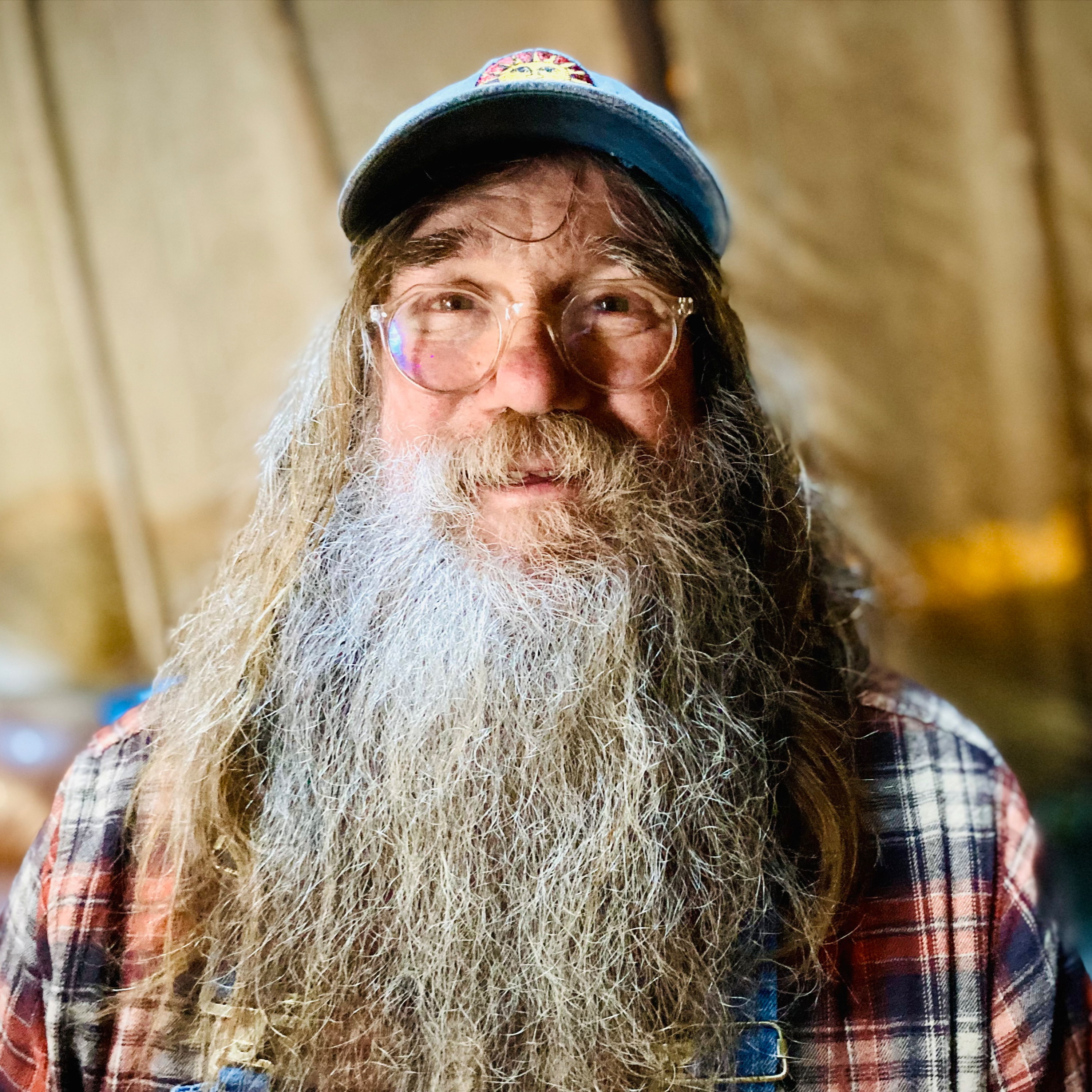
Hoppy Quick has been chainsaw carving bears in the Catskills since 1979 — but he'll tell you he's not an artist. He's a spiritual being who found himself through the bear.
In this wide-ranging conversation, we visit Hoppy at his home in Samsonville — a converted 1951 school bus, a canvas teepee workshop, a crackling fire ring, and a horse named Ginny — and quickly discover that a conversation about whittling wood leads somewhere much deeper.
We talk about his 47-year search for the perfect bear face, carving as meditation, and what it means to live in grace. Hoppy shares the story behind the Heart Tribe, his COVID-era community of tens of thousands, and reflects on ego, fear, the divine feminine, AI, and why he believes the path forward is exactly 16 inches — from your head to your heart.
As the world seems to be straining at its seams, Hoppy emerges like a bear from the tree line — unexpected, unhurried, and offering a wise and grounding call to our higher selves.
Transcription by Jerome Kazlauskas
[00:00:00] Hoppy Quick: I have to see myself as the bear, as the oak tree, or as the pine tree because the pine has given to me as much as the bear, especially now in these political times where we have this disconnection with each other and the planet, and I think there is a shift in a consciousness of a higher frequency, and the only way we can do that a lot of times is to not bury our heads in the sand but to try to evolve to where maybe we can help the world by just trying to get to that place the human being was always supposed to get to.
[00:00:38] Brett Barry: Welcome to "Kaatscast: The Catskills Podcast," where over the years we've had a number of requests to interview Hoppy Quick, a Catskills woodsman who's famous for his chainsaw-carved bears. He'll tell you he's not an artist, but when you see his work, you'll understand he's just, well, not a big fan of EGO. Hoppy lives intentionally in a converted 1951 school bus next to a corral for his horse Ginny, a small barn with miniature horses Rocky and Louie, and a huge canvas teepee, which encloses the workshop with a crackling fire ring. We came ready to talk wood and chainsaws and bears, and we got a lot more. I'd say Hoppy's a bit of an oracle, and our conversation ranged from nature identity to human identity and spiritual frequency, from AI disruption to the analog life, from the patriarchy to the hive mind, via "Stranger Things" to Head and Heart, Jesus, the Buddha, grace, and abundance. Hoppy Quick is a real Catskill character, and we are excited to introduce him to you right now.
[00:01:52] Hoppy Quick: My name is Hoppy Quick. I'm a woodcarver. I've been a woodcarver since 1979. I was like 15 or 16. We're in Samson, well, Accord, on the edge of Accord in Samsonville, New York, but my family lived over in West Shokan when I grew up. Under the reservoir, I had family. We've been here a long time, and up in West Shokan, I had—up in the Peekamoose, I had a great-great-grandmother, you know, and a grandfather, so we've just been here forever. Mostly, I spent a lot of time with a great-uncle, and he would tell me stories about herding turkeys from Pine Hill down to the train station under where the reservoir is, and when they were kids, there were water boys for the crew that was building the reservoir, so they walked around with a ladle and a bucket of water, and, you know, they told me stories about my great-grandmother who lived up in the hollow, and they told me that they would get in a wagon and ride from Hurley and go all the way up, and then they'd, like, have milk and cookies and stay for a half—take them like a day and a half to get there—and have milk and cookies and stay for like an hour, then she'd say, "You have to go," and they'd get back in the wagon and head back down the mountain, yeah.
[00:03:00] Brett Barry: What got you started on whittling and carving?
[00:03:03] Hoppy Quick: I've been whittling since my father gave me my first knife when I was probably 10, and that was—he got it out of Singer and Denman right there on 28 out of high school, and the hatchet, I was building forts and building things out of trees, and then when I got a chainsaw, we were cutting firewood. I was working for a logger. I think I was 16—15 or 16—in 1979 maybe and waiting for him to skid out tops. I carved an owl. I thought I invented a new art form, you know, but obviously I hadn't—the West Coast had been doing chainsaw carving for a long time.
[00:03:36] Brett Barry: But what about here? Were you one of the first people to do that here in the Catskills?
[00:03:38] Hoppy Quick: Yeah, in the Catskills, I was probably one of the first, yeah.
[00:03:42] Brett Barry: And what attracted you to bears?
[00:03:44] Hoppy Quick: Oh, bears, that's so... there we go. That's a whole other thing. I'm a spiritual man more than I am an artist or a sculptor, so the bear, my father had a connection to the bear. He thought that's what God looked like, so from a very young age, my mother brought us up Catholic, but my father was very much in tune with the woods, so he had me out there every chance he got, and he really, really, just really adored the bear, and so I started counting bears—every one I've seen since I was seven or eight years old. Yeah, I lost count now because it got past a hundred, and I just, you know, I just see them all the time, and now my daughters passed that on to my daughters.
[00:04:23] Brett Barry: Do you have a spiritual connection with the animal?
[00:04:26] Hoppy Quick: I could tell you this: there's a lot of chainsaw carvers now, and they're very, very good, and it took me almost 50 years—47 years of carving—and I just found the bear that I wanted to do when I was 15, like three years ago. I made the face that I tried to make way back then, so I'm not really a great artist, but I am very patient, and I just have an image in my head that I had to just keep doing over, so basically bear—carving bears here in the Catskills has been my mantra. It's been my meditation, and so I found my spiritual self through the bear, and, you know, we kind of came through that journey together.
[00:05:06] Brett Barry: What was it about that bear?
[00:05:08] Hoppy Quick: I had a picture in my head of the face of a bear that I could never do where I was happy with it until I think in my 44th year of carving that I looked at this bear and just said, "I found you." You know, I found it, and then I felt like, "Wow, is it all over?" Like, I ended up making a life around the bear through this, through this obsession, and I'm a bit on the spectrum too, so... OCD: I do something over and over and over again till I get it right, and like I said, I tell carvers all the time, I'm—if I were any good, I would've been somebody's carver. They're doing unbelievable carvings after five or six years, and they're doing all different kinds of things, and I just keep doing bears, and not because it's the only thing I can do. It's because it's the only thing I want to do. I don't have to think. I just go into this meditation with it.
[00:06:03] Brett Barry: Is the bear already in the wood?
[00:06:05] Hoppy Quick: Yeah, yep, everybody says, "Oh, you see it?" And I'm like, "Well, it's a cylinder," and it's different-sized bears, and it is just a matter of getting it out, but I have to work within a cylinder. It's not square. It's round, so, you know, the furthest points are out, or when the arms are standing or when I've, if I'm doing them on all fours, I do them in all different poses, mostly remembering bears that I've seen in my life too. A lot—a lot of the bears I've carved, I'm reproducing that memory.
[00:06:35] Brett Barry: So you do this all with chainsaws. How many chainsaws do you have? What are your favorites?
[00:06:39] Hoppy Quick: Well, I got these. I use the big one to chunk out to get the bigger chunks out, and then I use pretty much—I'm very simple. A lot of guys have like 10 or 12 saws. I got like three. I use Stihl, and this is the MS 250, and I've gone through, I don't know, how many of these? I go through about two or three of these a year. Now, I'm 63. I don't do as much, but yeah, I mean, when I was really, you know, when my kids were small and I had to make a living, a lot of the meditation was there, but it was also the thing like, "You've got to pay the bills, you've got to feed the kids, you've got to—everybody needs something," so I kind of was turning into a little bit of a factory. I was factory-ing them, and I didn't like that, so when I turned 50, I said, "I'm not going to take commissions anymore." I'm just going to carve for myself, and the other thing with that was when I was doing commissions, I was always—how much to do this, how much to carve a hippopotamus, how much to carve the—I said, "I don't know," but I had to give prices for things, and then I'd always cut myself short because I never wanted to overcharge, and I always overdid the work because I was always OCD and just... so anyway, when I stopped at 50, kind of my carving stalled out from a period when my kids were small and the bills had to get paid. I was still doing it, and I was still in that meditation, but it was also creating a life for my family, and then when everybody grew up, I was kind of doing my thing, and I mean, I've never become a wealthy man from this because I've never really overcharged, but... and also be... me being kind of like a monk. I sit and stare a lot and ponder things. You know, I see myself as nature. I don't see myself as a human being. I identify as nature first. Before the bear is the bear, the bear is nature; before the hawk is the hawk, the hawk is nature; and the same with the trees, everything is part of something bigger than itself, so to know that the human being has so much that we have the ability just to put all the surplus stuff away and take all this abundance from the earth and just kind of store it away so that we have this security. I didn't like that. I wanted to live closer to nature. Closer to nature is to be... you're living when you're surviving.
[00:09:13] Brett Barry: Yeah.
[00:09:15] Hoppy Quick: My daughter's always said I was always content. I've never wanted anything. The only thing I've always done is... when family and people I've always been with is... try to get them what they need, but I've really never needed anything, you know, fire, you know, maybe a knife. Even with this, I picked up spoon carving with axes and knives because I knew one day when I got old, I didn't want to hear the noise of this anymore, and I didn't want to breathe the fumes, so what could I do that would be another meditation? So that's a spoon I'm working on.
[00:09:47] Brett Barry: Wow!
[00:09:47] Hoppy Quick: But it's a bear. You know, I call that a "bear tongue" in my soup.
[00:09:54] Brett Barry: And this is all—you don't do this all with a knife?
[00:09:56] Hoppy Quick: Well, I take it out with a hatchet. I did take a grinder and kind of shape out the bear's head a little bit because it's just—it's so many hours. Like, if you were to do that, start to finish with a knife, it would be way beyond, and I don't get enough money selling spoons. I get like maybe 10 bucks an hour, you know, so if you had to do that, you'd even get even less, you know, but that'll take me a couple days to sit and whittle to. You know, what can you sell the spoon for?
[00:10:22] Brett Barry: You said you stopped working for commission years ago. Where do your bears wind up?
[00:10:26] Hoppy Quick: That's how I found the bear that I had been looking for. That was the magic step right there: saying, "Enough, I don't want to carve for other people." I just want to carve for myself, so when I did that and there was no budget, there was no budget that was holding me back. I was free to do and take a carving to whatever level I wanted to, and I went deep into the bear, like deep into, like, you know, eyelids and, you know, hair. I just got into not just chainsaws but now power-carving tools and hand-carving tools to try to make the bear as realistic as I could, and when I did that, I was, I thought, like, "Alright, I've reached my goal. Now what do I do?" But then I was like, "Well, you didn't really, because when you see a bear in the woods, you don't see a bear in the woods from like six inches away." You see the bear in the woods as a glimpse. It's on the horizon, and you see this black portal. Usually, you don't even know it's a bear. It looks like a black hole, and it's just like you go into that black hole, you know, and it's just like it just kind of grabs your breath, so I said, "Alright, how do you get that?" So it's just now it's just going to be form. It's just going to be a shape and maybe just something really dark and like a portal, you know?
[00:11:39] Brett Barry: More abstract.
[00:11:40] Hoppy Quick: Yeah, kind of more fine art. I think that's the difference. You know, some people have to see every little detail, but most people—they appreciate the form. I mean, since New York City's been coming up here, I've learned so much from different artists that live in the area. This is if you were primarily—this is folk art. You know, the majority of the chainsaw carvers will carve, sit on the side of the road, sell bears, sell whatever, and I did that for years, and I don't know if we even take ourselves seriously as artists. You know, like I said, I'd never thought of myself as an artist. I always thought of myself as a spiritual being, so Alan Watts has a story about an emperor who hires an artist to make a painting of a crab. I want the most beautiful painting of a crab that you can do, and so the artist leaves. A year later, he comes back. The emperor never heard from the artist. The artist shows up, and he says, "Whatever happened to the painting?" I commissioned the crab, and the artist says, "Oh, you want a crab?" So in 20 minutes, he paints this beautiful picture of a crab, and the emperor says, "If you could do that that fast, why did I have to wait a year?" And he goes, "Well, it took me a year to study the crab because I had to become the crab to paint the crab," so my whole life is about becoming the bear. I mean, I am a bear.
[00:13:00] Brett Barry: Tell me about the connection when you encounter a bear.
[00:13:03] Hoppy Quick: It's definitely a deep spiritual connection, and there's usually some kind of symbolism in it. See, that's the thing that the human being lost. Now, we're going to go into my spiritual things because that's who I am [really] if you wanted to know who I was. There's a frequency that only humanity has that is created, and it's based on a lower vibration of the human ego, and then there's the human soul, which is connected to everything, and that frequency is the frequency of the universe and the frequency of nature, so we're all like just single cells of the divine body of the universe, but the human frequency, this lower level vibration, it's all about fear and control and all the negative parts of us. This does not resonate with nature, so to put myself in nature, I wanted to resonate with that vibration, so I have to see myself as the bear, as the oak tree, or as the pine tree because the pine has given to me as much as the bear, especially now in these political times where we have this disconnection with each other and the planet, and I think there is a shift in a consciousness of a higher frequency, and the only way we can do that a lot of times is to not bury our heads in the sand but to try to evolve to where maybe we can help the world by just trying to get to that place the human being was always supposed to get to, and we kind of have been on the wrong road, you know.
[00:14:32] Brett Barry: Does that discourage you from looking at what's happening today, that we may not get there?
[00:14:40] Hoppy Quick: I think we're in it right now. I didn't even know. I mean, since YouTube shows you all kinds of stuff, there's all this talk now about the third density in the fifth-dimensional frequency.
[00:14:51] Brett Barry: The third density refers to our current plane of human existence, including self-awareness and the ability to choose service to others over service to self. The fifth-dimensional frequency: a state of consciousness that moves beyond fear, ego, and duality and toured love, unity, compassion, and peace. Hoppy continued pointing to his head and then his heart.
[00:15:22] Hoppy Quick: All you got to do to find yourself is go 16 inches, you know, from up here down to here. You can think and feel and speak right from your—from the center of your being, and the center of your being is sustainable because it's connected to everything around you, but the human thing up here is not sustainable. I always said it was going to implode and we're—I'm seeing the implosion now, but a lot of people that I love and care about, they care about maybe this person, and then I have people that I love and respect and are over here, and they think differently, so the same people that I love on both sides are fighting. I hurt over that, so a lot of times I can be a hermit, and I can go inward, but at the same time I'm trying to protect my frequency because the only thing I can offer the world, you know, is just like that glimpse of the bear when it shows itself to me, that black portal, that mystery that I look into, and I just say, "Oh, there's a door on the horizon, and I've got to go through it, and it's the bear." I've got to—I've got to try to be that too. I don't help anybody by being angry or going in and beating my head in an argument that I'll never win, but it'll only make me live at that lower vibration. Let me just say this. I was going through something, and I saw somebody's commented, and I got—immediately—I got reacted to it, so the first thing I did, I commented on how I reacted, but I didn't send it, and then I said, "Okay, if I want to communicate with the opposing side, I can't do it from here." I can't. I'm pointing at my head, so you guys can't see that I'm pointing at my head. I can't do it from here. I have to do it from my center, so this is the only place where the communication will be heard, so if two people are coming at each other from the head and not from the center, they're never going to understand each other. So if you respect the other person, you don't have to like their life or what they do, but if you want that to be heard, then you have to come from the center of your being.
[00:17:26] Brett Barry: How do you do that?
[00:17:28] Hoppy Quick: Protect your frequency, and your frequency is this: everybody's got to do the inner work of getting themselves that 16 inches from here to here. The world wants to keep us here. That third-dimensional reality [that ego reality] wants to keep us up in our heads. When I said to human being disconnected from nature, it lost instinct. That's with the thing, so instinctually, if you connect at this higher frequency, you're getting your instinct back, which was just to tell you that you are godly, that you are part of something bigger than yourself, you know, from worm to whale. You are in there with it. You know, we're not above it. The human being is not above the planet, not above the universe, and not above the other animals [that it's special] because that's just ego, you know. I mean, I go about my day, and I look at people, and I see them as animals. I see different animals, and different animals cross my path. The ravens live over the top of me. They live here. I love it when I'm walking and all I hear is the wind under feathers, and I'm just like, "Oh, the raven just went over." You know, I'm aware, and I think that's what this is. When you reach this higher frequency, it means that you are aware and you are awake to who you are—not about worrying about your neighbor, not about worrying about some family member that doesn't think like you or a friend that doesn't think. It's about you being aware of yourself, and you have that inner dialogue from the top of my head to my heart. This has a voice. The center of my being. My heart has a voice, and my head has a voice, and I can tell when I am in my ego. If I'm in a lower frequency, I can tell by the sound of my voice. I can tell that when my voice is soft, it's here and it's more, and the wisdom's here, so basically once we're here...
[00:19:20] Brett Barry: In the middle.
[00:19:21] Hoppy Quick: ...in the middle, in the center of our being, we are connected to the consciousness of everything, and then we have instinct back. We understand who we are.
[00:19:31] Brett Barry: What helps you get there?
[00:19:33] Hoppy Quick: Listening. Listening to myself, it's not so much that I would think about what my neighbor's doing. It's more about, "What am I doing? Am I yelling?" So now I think the trick is I never let anything pass from my brain, from my ego, without checking in with my soul first to see if… it edits everything that comes out of me. I'm a believer that religion sometimes was meant to suppress the soul and not free it. Everything gets infected with human ego, and once that happens, then it's not real, but I don't. I do believe that if you have a belief, however you perceive God, like in a bear or in Jesus or wherever or in nature, nothing should be between your heart and what you see: religion, a book... anything would be something that's meant to slow down, slow down on your progress, to find yourself.
[00:20:32] Brett Barry: Hoppy's Thoreauvian views on religion, spirituality, and nature made me curious about his nonconformist lifestyle, working in a big teepee and living in an old school bus.
[00:20:45] Hoppy Quick: Everything in my life has been given to me. That's the other thing. When you're a spiritual person and you work in grace, grace being that, like, I went to the laundromat yesterday, and I dropped the quarter, and the man said, "You dropped the quarter," and I said, "It's no longer my quarter," and he goes, "Well, I told you it's there." I said, "Well, then, it's your quarter," and he didn't understand, but everybody that's out there that's needing what they, you know, somebody could use that quarter, so this bus right here, my ex-wife had a change of life, and we split up, and I really was missing my daughters because they were mostly with her, and I asked the kids, and I said, "Really? I'm really, really sad." You know, I miss you guys, and I want to spend more time with you, and they're like, "Well, Dad, what do you want to do?" I said, "I want to get a bus, and I want to be, like, a little like a bohemian or whatever," and they're like, "Well, then, do it." You know, so the big story was I was living here on the property by myself, and I said, "Well, do you guys want the property? Do you guys want to live here?" I told my ex, "Nah, no, we don't want to live there," and I said, "Because it's sad we grew up there," and I said, "Yeah, I know." I'm sad. I said, "But I'm going to let it go," and they go, "What do you mean, 'let it go'?" I said, "I'm just going to—I'm just going to let it go." I'm going to let it go to the bank. I'm going to let it go back, and so in that moment, I stepped off that ledge, and I went on Craigslist, and I found this bus in Connecticut, and I didn't have any money. It was January, and I took the pic [the ad from Craigslist]. I put it on top of Facebook, and I said, "If I've acquired any spiritual power, I need to manifest this," so the next morning I had it, you know, in my Messenger, and it was this woman Janet. She goes, "Hoppy, I'm down in Florida." My mother passed away out in California, and she left me some money, and I would like, in memory of my mother, to buy you this bus, and that was like $6,000, and I was like, "No, can't do that," you know, and I called my mother right away, and I said, "Mom, this just happened," and she goes, "Well, you can't—you can't tell God how to bring it to you when you ask," so I said, "Yeah, you're right." So we—I talked to her, and she goes, "I'm down in Florida. I'll be back next Friday. Meet me in Woodstock. We'll walk across the street to the bank. I'll give you the money. Tell the guy you'll take the bus." I get another message from this guy I know who lives over here in Kerhonkson who does rat rods, and that's a 1951 school bus with a flathead, and he goes, "Hoppy, what's the story with that bus?" I said, "Well, this woman wants to buy it for me." He goes, "Well, I want to fix it, and I don't want any money," and I was like, "What?" And he goes, "Yeah, I just want to. I want to get that bus." If you get that bus, you have it brought here, so I got to Friday. Janet's up from Florida. She says, "Hop, you're not going to believe this." I got home from Florida. There was a check in the mail, and it's $6,700, so I'm going to go cash this check and give you the whole $6,700. I'm like, but the bus is only $6,000. She said, "This is from my mother and my grandmother, so we go over and we get the money." The next day, I go down to Connecticut. I pay the guy. He goes, "It's $6,000 for the bus." I don't haggle. I say, "Here's the $6,000." He goes, "It's $550 for the trailer to go to your buddy, and it's $150 for the storage." It was $6,700. The bus came back, the magic happened, and it's truly a magic bus. You know, when I got back, my ex says, "Hey, you know, we need a place to live," and I'm like, "Well, go down to the property. The foreclosure came through, and I get—I go down to the county courthouse with nothing: me, and I just sit there. There's lawyers for everybody else who are doing all these foreclosures in one day, and I'm just sitting there watching, listening, and thinking, like, wow, I didn't bring a lawyer. I didn't bring the deed. I didn't—I didn't even bring a checkbook, I didn't do anything, and they called me up, and the judge says, "Mr. Quick, do you want to lose your house?" And I said, "No." The lawyer for the bank said, "You don't want to lose your house." Give us five minutes in the hall. We go out, we make a deal. I got my property back, and I got the bus. That's my whole life has been like that. There isn't a thing on this property that I haven't gotten from somebody else. This teepee, I went to Tetta's, and this really nice guy Matt—he's a good friend of mine. He had it in his yard. He got it from some guy who had it in storage. It came from the UK. It's not like a First Nations teepee. It's like the English version of a Native American teepee. I think the poles came over on a boat. It was in a storage unit, and he gave it to me, and we put it up. Wasn't looking for it. It just came. Then the kids come home and say, "Hey now, they're back home." Both my daughters are here. Take the house, take whatever. I'm staying in the bus. That's my life. The barn over here and the neighbor had over there. They had antiques. The lady passed away, and they said, "Do you want this barn?" Yeah, I went over with a trailer, jacked it up, brought it over, and we had dairy goats in there, and now the mini horses are in it, so we don't do anything, I don't believe anything on our own, in my experience, grace, so I have to be aware of what I give out. I can't be shy on saying, "Hey, wait a minute." I'm not supposed to give now. There's somebody asking for something to the universe, and if I believe that everybody's got God inside of them, I see God inside of myself. I have to see God in everything, even if they don't see it in themselves, even if they're angry and hostile. I have to believe that their soul is connected to this—this bigger thing. They're making a conscious choice to live at maybe a lower vibration, but they still have this if they need it, and it's still connected, you know, so everything that I've gotten in my life, I've never gotten. People just took care of me as an artist here in the Catskills, people buying my bears. I'm sure they liked my carvings, but they also loved my way of life, and so they supported me, and they took care of me.
[00:26:44] Brett Barry: Can you tell me about the Heart Tribe?
[00:26:47] Hoppy Quick: Heart Tribe started out during COVID. I saw that a number of friends and family just on my following that they were scared, and, you know, I had to drive my mom down to the doctor because she had Lyme disease. She had to get an antibiotic [IV antibiotics], and I had to sit there for half an hour, and I just remember sitting there after I took a picture of myself in the woods and said, "Don't panic." It's okay if you want to paint. Paint if you want to learn to do it. If you want to play an instrument, this is your time. The world's telling you to stop, and it's okay, so I did this thing, and it went semi-viral. I think I had, like, 90,000 something, but I just know I had, like, all these comments, and my phone was going ping, ping, ping, ping, ping, ping, ping. Like, in an hour I got, like, 25,000 followers. My advice for people as the world begins to shut down around us: look for those things at home you wanted to do but didn't have the time for. Start your seeds, think ahead to your garden, and create one. If you don't have a yard to get pots or anything, you can hold the dirt and grow food in it. It will make you feel better. Fishing season is coming. Avoid people, but don't avoid water or the woods. Nature is good medicine. Optimism is your friend. Always be optimistic. Money will be tight, but it doesn't mean you can't do things. A good time of year to clean your house and property. If the world is forcing you into isolation, embrace it. Quarantine doesn't have to be scary. There will always be that pessimist, you know, the one when you say, "It's a beautiful day." They say, "But it's going to rain later." We are all dealing with the same pandemic. Let your positive outlook help get you through to others. Don't get caught in panic. Just breathe. By no means does my optimism mean I don't care. I just believe in the magic of good intention. Support each other with positive vibes. I wish you all good health, which is... close to the date, March 13th, so I got up the next day, and I did a video, and then they asked me. I just said, "Listen, you guys are so kind, and I'm glad this helped," and they said, "Well, hey, can you keep doing this?" So I said, "Alright," so for like 70 days I did a live video, so I would go in the woods, and I called them the Heart Tribe because we were out of our heads. We weren't going to come from here, not from the head, but from the heart, and so that's how the Heart Tribe came, and then it became to grow and grow and grow, and then we had, you know, at some times I think we had four or five hundred people on live.
[00:29:18] Brett Barry: And it became a real comfort for people, for you too.
[00:29:20] Hoppy Quick: It was comfortable for me, and it gave me something to do. This is where something you can do is just by being yourself and being positive can help the world more than you putting your head into a fight. You know, I mean, I'd be the first one to jump in if somebody's getting... especially children, women, or anybody that's... you know, my father taught me, you know, to take down the bully, and I think we're seeing a lot of the patriarchal society collapsing. In my eyes, this is a good thing. It's not the way men were supposed to be. You know, my father always taught me before. Before you eat, your children eat, you know, before you sleep, and everybody's got a warm—I mean, I'm going to cry over my dad, but it's the way men were supposed to be, and we say we have to find that back, but men don't really know how to be. We've always been on the wrong road of evolution in our generation, you know, for thousands of years. You know, when we created God in our image, that's when we got the ego involved, and we cut out the planet. We cut out the universe, so it's the rise of the divine feminine right now, and I got two daughters, and we got all this horrible stuff going on with all these wealthy... I mean, I just did a live, and I don't know if it's okay to say this, but I just did a live, and I said, "I surrender my white privilege. I surrender my male privilege because it's time." We can't cure any of this unless somebody like me, a white guy, you know, with no political affiliation, speaks up and just says, "You know, enough is enough." You know, people are being hurt and people are being killed, and we're better than this, so now how do we pick up in this moment where everything is maybe splitting apart and we're about to get on maybe a different path of evolution? So then, you know, there's a group of women that meet here once a week. My kids and their mom and then their friends, our friends, and we all talk about it, and I'm here to tend to fire or whatever, but it's supposed to be. Men are not supposed to have a fist. They're supposed to be putting their hand out to help people up. The leader should have everybody has food before the leader eats. Everybody should have a warm place to sleep with a roof over their head before they do that. That is true alpha energy, you know, and if I keep silent about it and I go about my hermit life and I don't speak up, maybe there's people out there that maybe do have a little respect for me that say, "You know, Hop looks like a big redneck. You know, he looks like the big hairy guy, and maybe there's something to this. Maybe it can help." I mean, I did get some flak from it, but that's okay. Everybody's entitled to an opinion, and the thing is, I don't go to ego, you know, and I'm a true believer that all these spiritual people that people have created religions over were just human beings that overcame themselves, and I think, well, in a lot of ways [when religions put these people up on pedestals]. They take away their power because, you know, I have a beautiful woman who lives down the road. She's born again, and her and I have great conversations, and I never disrespect her, and she doesn't really disrespect me. We just have this conversation, and she'll say, "Do you believe in Jesus?" And I'll say, "Yeah, I believe in Jesus, the man," and she says, "Well, no, there can only be one," and I said, "Well, no." I said, "I think it's more important that we can aspire to be that good." Why can't we have it in us to become Jesus? You know, it's easy for us to think that we can be that bad, that we can be that dark and evil, but why can't we be that light? These are strange times, but they're also times that were meant to happen. I think somehow this was supposed to be the wake-up because all of this underlying stuff has always been there, and that's the scary thing. It's not just like it just arrived. It just, it's always been there, and it's just coming out into the open, you know?
[00:33:24] Brett Barry: And you think that will have, in the long run, a more positive reversal?
[00:33:29] Hoppy Quick: I think the people, the empaths of the world, are going to stop giving your energy to the narcissist of the world. That's—that is the evolution of that ego frequency. What is the evolution of the heart frequency? It's infinite. It's love. It's forgiveness. It's all of these positive things. The frequency of the ego is just going to be self-centered, narcissistic, sociopathic, and psychopathic. It just keeps growing until it implodes, and then it becomes a kind of a hive mind where it's like, "My daughter just watched 'Stranger Things,' right, and what's his name?" The guy with that who looked like a tree.
[00:34:11] Sierra DeVito: Vecna?
[00:34:12] Hoppy Quick: Vecna?
[00:34:12] Brett Barry: Vecna.
[00:34:13] Sierra DeVito: Vecna.
[00:34:13] Hoppy Quick: Vecna, okay, and then what were the creatures?
[00:34:16] Sierra DeVito: Oh, the Demodogs or the Demogorgons.
[00:34:18] Hoppy Quick: So I'm not saying this about anybody. I'm just saying that the hive mind means, above all things, that make any sense. No, nobody's thinking for themselves. They're thinking with the hive mind, and that's the thing that we can't stop. That's—that is that imploding ego frequency.
[00:34:39] Brett Barry: But will it take us down with it?
[00:34:41] Hoppy Quick: No, no, I have hope and I—because I'm a believer—God is experiencing being life through everything. Not just us, but through the oak tree, through the bear, through the dog, through the horses, through the grass, through everything [worm to whale]. It's all part of the experience, and when we can connect to the center of our being, we are in a conduit now to the consciousness of that. To me, I tell my daughters all the time, there's no greater thing than to know that there's, when you can stand and know that you have all the planets and all the stars and the moons of all the galaxies and all the animals at your back, but if you're in this lower vibrational frequency and all you have is the hive mind of the same, like everything has to be the same, it goes nowhere, but no, I have faith. I have faith that this is going to happen, that it's had to be a thing, and yes, I find it very sad that people are being hurt and killed and mistreated and tortured, and the only way out of this reality is for each individual to overcome themselves and rise up to a higher frequency, and it's okay to stand in protest, but in a way where you're set to what I'm saying before and it's happening. You look at different people standing in the frog suits, and they're not being violent. This is going to pass. This is going to pass, and some people are terrified, and, you know, all these people that are terrified of change and all these people that are afraid—we all were in the same bubble. We were all in the same little snow globe, but some of us had maybe better parents, had people that, you know, that's why it's so important to love your kids. It's so important to have grace and give your coat to somebody that needs it, even if you don't have a coat. That's the way you build grace, and grace is like a form of loving currency. Everything I got in my life is from grace. I told friends of mine, I'd say, and they were more progressive, and they would say, like, "Oh, they're not accepting this," and I'm like, "They're not. It's not their generation. You can't expect an 80-year-old person to understand transgender." They don't understand what that is, and you can't get angry with them because they're from a different time. You can't put everybody in the same thing. You know, everybody has a right to experience life the way they want to see life, however they want to see it, to me. If somebody identifies a certain way, well, that's their right, that's their privilege, but also don't—the older people—they have a right to be given some time. You know, I think we're a little harsh on older generations that don't understand, and, you know, believe it or not, a lot of the people—we have to understand that even politically, a lot of what people are going through right now, it's not that they're hostile. It's just that they're scared because they've only known one way, and now all of a sudden everybody's telling them, "No, you've got to understand this, this, this, this, and this"—so many things—and they can't see it, so... but there's a way to speak to them so they do, and it's not by calling people names, no.
[00:38:03] Brett Barry: I guess I want to talk to you a little—just a little bit more about your craft. What is your day like? Do you come out here every day and carve?
[00:38:12] Hoppy Quick: Well, the first thing I do when I wake up is I meditate, and I give gratitude for everything in my life, and depending on the temperature, I go for coffee, I go out for breakfast, and if it's nicer weather, I pick a log, and I figure out what I'm going to do, and some days it might be just, "I want to do a spoon." Some days I want to take my pack basket, and I want to take my tools, and I want to walk out into the woods and make a spoon. I might hike up there and find magic wands. Sometimes I do that. Believe it or not, people actually like my magic wands because they have stories. I have cutting boards. Sometimes I'll do them. Sometimes I'll do absolutely nothing but just sit and stare and think about this stuff. Go for a walk around the reservoir. Today, I went to the Garden Show with my daughters to be in the greenhouse, and we got a cake. We got a strawberry shortcake, and then... so that was like the highlight of our day, and then you guys were coming, so I got a fire going. I got some blanks out while I was waiting. I don't have an agenda. I don't have a goal.
[00:39:24] Brett Barry: But is there a legacy that you want to leave behind?
[00:39:29] Hoppy Quick: My bears, my bears, I got a bear on top of Stratton Mountain, the ski resort. It's blessing the mountain I got. I would love to be able to travel and leave a bear in every state. I would like to leave a bear at the Adirondack Museum. I want to donate one there so they have it in a museum. The other thing is I like people to remember me as having it. It was a guy with a big heart, and I cry a lot, like I'm crying now. I will cry right now. I cry a lot because I'm deeply spiritual, and what's happening in the world is sad and if I let the sadness change my emotions to anger and hatred, well, then, that world wins, so I guess that's where I'm coming from. The best thing that I could do to fight whatever's happening out there is to become really, really loving and embracing myself so that I don't get into conflict. I will go with friends to the "No Kings." I think that if a bunch of human beings are together being... because I believe that every human being is... resonates with that divine consciousness of the universe, that... if everybody, instead of yelling, and I understand the frustration and I understand everything, and believe it or not, I understand. You know, it was a time—I'm going to say this very briefly. There was a time when I lived at my mother's. My mother had beginning signs of dementia, so my sister said, "Can you pull your bus up to Mom's, and can you work from home up there at Mom's, and you could watch out for her because we'd all feel better?" And I did that, and my mother and I were attacked because I chainsaw carved.
[00:41:24] Brett Barry: That complaint came from a neighbor concerning noise, fumes, and zoning codes.
[00:41:30] Hoppy Quick: And it was funny because if I had to think of left and right, the left was trying to tear me down. The left wanted me to stop. They got together. I went to the Supreme Court, the group of left people. He tried to stop me, and I, everybody would say, aren't you getting angry? I'm like, no, because if I have, I have more power. If I go in and say, "I understand we'll do what we can," I will never try to get angry, and I went through it that way, and in the end, to more of the right-leaning people, we're trying to say, "Live and let live. Leave Hoppy alone." So how can I pick a side? The only thing I pick a side of... it's not a political side. I will choose heart over ego, so if ego is present on a political side, you follow me, and if the heart is present in another, I will always lean towards the heart's side. I never wanted to be labeled because once you're labeled, you go into a box, and the only people that you can talk to in that box are the same people like you, and everybody already is feeling it doesn't matter, but if I stay in Enigma, if I say this enigmatic being like Tom Bombadil in "Lord of the Rings," if I could be this person that the ring doesn't have the power over, that the powers of Mordor don't have the power over, none of this has the power over Tom Bombadil because Tom Bombadil lives in his own reality, and he lives a loving, peaceful life, you know? So in essence, that is God in my eye. If you can reach that place of... I hope one day that I can be an enlightened person like Buddha, or I can be like Muhammad, and I can be like Abraham, and I can be like Jesus, and I can be like, you know, Gandhi. I can be like all of us have. We can all be that. It's just a choice, you know?
[00:43:24] Brett Barry: Maybe you already are.
[00:43:26] Hoppy Quick: Well, yeah, maybe, but I know I got a lot of things I'm working on. I'm only going to try to give you the very best of Hoppy Quick, but I fight daily with judgment, passing judgment, just not, you know, sometimes the world doesn't move fast enough for us, so we want to pass—we pass judgment, but don't pass judgment yet because there's a chance that somebody's going to learn a lesson, and they're going to climb out of that, and so now it's like, "Okay, this is kind of a schizophrenic moment that we feel like we have these two personalities of ourselves." We have our identity that we've created and our ego and what is really not the identity that we've created but everybody around us has created, and then we have this identity that we would like to be better, and so there's always sometimes an argument between my head and my heart, you know.
[00:44:20] Brett Barry: At this point in the conversation, I figured we'd taken Hoppy away from his work for enough of the afternoon, and I asked if he'd like to get back to some wooden spoons he'd been crafting from firewood-shaped chunks of raw walnut.
[00:44:35] Hoppy Quick: So I'm going to—I did a centerline on this piece of wood, and I start my spoon back from this end because there might be an end check from drying, you know, so I don't want that check in the spoon, and I don't want it there. I want to make a salad set of bear paws where the claws actually are real and they come around, so this is going to be the paw, so these will be coming around like that so you can grab your salad. I'll make two of these, and then usually I put one of the oldest symbols: the spiral. That's usually my mark, but I'll probably define each claw so it's separated so that can hook into them, so it'll just be two bear paws. My dream is to make a simple spoon that you can stir your soup, but I can't do it because I always gotta throw something in, you know, like a Gaia or like a bear head, but there's something really, really beautiful about a simple spoon. You know, this is one of those things. I thought that when I was traveling, if I needed a sandwich or I could get gas, I could find a piece of stick of wood on the ground, and I could make a spoon, and I could take care of myself. I'm going to start here, away from the shoulder, so when my hatchet comes down, I'm not going into the spoon and splitting the bowl off, so this is like a stop cut. See, I'm turning it from left to right, and now I have that high spot so I don't have to take the whole chunk out.
[00:46:17] Brett Barry: The fact that this becomes a spoon is incredible to me.
[00:46:20] Hoppy Quick: Yeah, it's really relaxing.
[00:46:26] Brett Barry: How often is blood part of the scene?
[00:46:27] Hoppy Quick: A lot, yeah. I got scars everywhere, and, you know, you're alive. I got hatchet wounds, knife wounds, and chisel wounds. When I was 17, cutting firewood with my father—tree, tree—I dropped and landed on a sapling, and I, you know, when you cut the tree and then the sapling springs up so it hit the bar into my knee, and I could see my kneecap, and I'm bleeding, and I go to my father. We didn't have insurance. You know, I go to my dad. I'm like, "Dad, you know, I cut my knee," and he goes, "Yeah," so he reached over and he tore the sleeve off my shirt. He tied it around my knee, and he said, "Yeah, when we finish this load, we'll stop at the store and get some stuff, some bandages, and Mom will fix you up." That was it. Never got stitches, you know, when I'm here and my daughter's coming back and the state of the world, we decided. My daughter said, "Dad, we want a homestead." We want to have more gardens. We want to grow more things, so we're actually, we're kind of going back to the way it was in COVID, and actually when I post things on the Heart Tribe, people are still there, and they still are fearful. AI has scared me off of social media a lot, so I'm thinking more analog, more like we don't know what's real and what's not, and so it's scaring people kind of, like, into that analog kind of world and into being able to have a conversation and look at a person, rather than text, see you, and talk to you. It's more than five senses again, you know? Now you can take—I want to carve a wolf. You can put it on a computer. A computer can 3D print it and make a model of it, and then you can carve from the model, and I'm not saying it's bad because a lot of people are saying AI is a tool. I don't think it's a tool like my ax. My ax is being wielded by my eye, my hand, my mind, my heart when I create, and thank God an AI can't really swing an ax right now, and if you want to know, artificial intelligence has been here forever. It's the human ego that is artificial intelligence. It wasn't true intelligence. This is instinct, intuition, this thing connected to the universe, knowing who you are, where it didn't have to be explained. We're trying to find that again, and the human being has never done that. We dismantled that whole thing just from the control of some other power that wanted to say, "Hey, we can't let them know who they are because then we can't control them, so now this is where we're at." We're at the place where the controlling people are losing control, and I believe that we are going to come out of this on top, a part of it, not everybody, and I'm not saying that they're lost. I'm just saying they're making a conscious choice to live in that reality, and others are making a conscious choice to live in this reality.
[00:49:33] Brett Barry: "Kaatscast: The Catskills Podcast" is a production of Silver Hollow Audio. This story was recorded by our production intern Sierra DeVito. Transcription by Jerome Kazlauskas. Explore our entire catalog of shows at kaatscast.com, fully transcribed and searchable, and if you like what you hear, please review and rate on your favorite podcast platform. I'm Brett Barry, host and producer. You can reach me directly at kaatscast.com. Thanks for listening, and we'll see you next time.


