Rooted in the Forest: Anna Plattner and Justin Wexler of Wild Hudson Valley
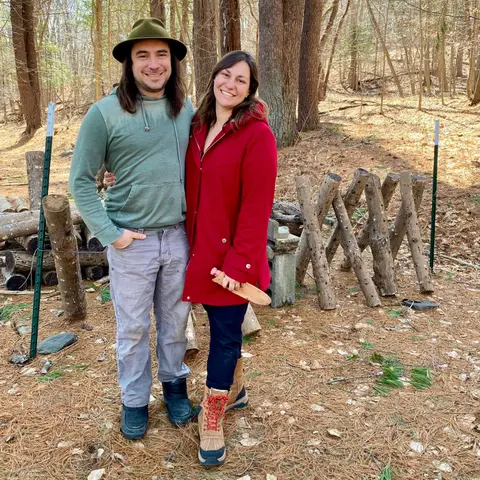
Brett Barry visits Anna Plattner and Justin Wexler at their 95-acre forest farm in Cairo, New York, home base of Wild Hudson Valley — an educational organization dedicated to inspiring learning and building connection through shared experiences in nature, history, and wild foods.
Justin and Anna trace the origins of Wild Hudson Valley back to 2013, when Justin, freshly burned out from a master's in teaching at Bard College, found his way back to the woods and a fledgling idea for an environmental education business. A serendipitous encounter at a master naturalist training program brought Anna into the picture, and the two have been growing Wild Hudson Valley together — personally and professionally — ever since. In 2021, they took the leap to pursue it full-time, greatly expanding their offerings to include eco camping, foraging workshops, and the Wild Harvest Box, a monthly subscription of wild-harvested ingredients for adventurous home cooks.
The conversation covers a rich range of topics: the history and cultivation of American ginseng (the plant that first brought them together), the ecology of forest farming and why it requires so much more than just planting things and walking away, the role of invasive species and deer in disrupting native plant communities, and the concept of ecoliteracy — the ability to truly read a landscape. We also draw some fascinating connections between the work of 18th-century botanist John Bartram and what Wild Hudson Valley does today, from "boxes" of natural specimens to a deep respect for indigenous plant knowledge.
Brett, Justin, and Anna also dig into some of the surprising edibles hiding in plain sight — stinging nettles more nutritious than spinach, common milkweed with more uses than most people imagine, and sumac cones their kids lick like lollipops. And they share the quiet but meaningful work of hosting Lenape and Mohican people on ancestral homeland visits to the Catskills and Hudson Valley — a practice rooted in gratitude and reciprocity.
For information about Wild Hudson Valley's eco camp, foraging workshops, the Wild Harvest Box, and property consultations, visit wildhudsonvalley.com.
And to hear a fun podcast about the life of John Bartram, check out Nature Calls: Conversations from the Hudson Valley, episode 115: John Bartram.
Kaatscast is a production of Silver Hollow Audio. Find us at kaatscast.com and on Instagram @kaatscast.
Production intern: Sierra DeVito. Transcriptionist: Jerome Kazlauskas.
Transcription by Jerome Kazlauskas
[00:00:00] Anna Plattner: Pretty much right about now, like end of March, early April, is when we really start to get busy again. We start to get some warm days where we can get out and start to do some spring cleanup and fix things, with our first programming starting around the end of April, so we jump right back in. May through September tends to be extremely busy for us, like burnout busy.
[00:00:28] Justin Wexler: Yeah, our time management trick is to make one day off a week. We've been trying to do that for four years, and we never get that day off, so...
[00:00:37] Brett Barry: Anna Plattner and Justin Wexler are the parents of two young children, which can be a full-time job in and of itself. Add to that their other baby, Wild Hudson Valley, on 95 acres of diverse forest, meadow, and wetland in Cairo, New York, with forest farming, eco camping, and a packed calendar of environmental education programming, and if you're a regular "Kaatscast" listener, you might remember Justin from episode number 101 entitled "Indigenous Catskills 101." It remains our most popular show. This time I met up with Justin and Anna on their forest farm, where they took a break from spring cleanup to talk about Wild Hudson Valley, an educational organization with a mission to inspire learning and build connection through shared experiences in nature, history, and wild foods. I'm Brett Barry, and this is "Kaatscast: The Catskills Podcast."
[00:01:42] Anna Plattner: Yeah, my name's Anna Plattner.
[00:01:45] Justin Wexler: And I am Justin Wexler.
[00:01:47] Anna Plattner: And the two of us run Wild Hudson Valley together.
[00:01:50] Brett Barry: So tell me how this all began.
[00:01:53] Justin Wexler: Well, in 2013, I had just graduated from Bard College with a master's in teaching, and I was totally burned out and needed to get back outside in the woods, and for a while I'd been thinking about starting a business in environmental education. Funny enough, a few weeks after I had graduated from Bard, I saw an advertisement for a master naturalist training program, and it turned out that Anna here was the one organizing it, and that's where we met.
[00:02:26] Anna Plattner: We got to know each other for a few years while Justin ran Wild Hudson Valley on his own, and then we began dating, and it took a new life of its own. For the first number of years that we ran Wild Hudson Valley, we both also managed American Ginseng Farm, a large-scale wild-simulated ginseng operation in the Catskill Mountains, but in 2021, we launched into Wild Hudson Valley full-time, both of us, and we have greatly expanded what we offer. We not only do environmental education now, but we have an eco camp with four campsites. We do a lot of programs, foraging workshops, and we have a product we call "the wild harvest box."
[00:03:12] Brett Barry: I was just listening to a podcast from "Nature Calls with Jean Thomas" and others about John Bartram, and I thought there were some real parallels there between John Bartram and what you're doing, and funnily enough, it was John and Anne and you are Justin and Anna, so can you tell me, have you made this connection before?
[00:03:36] Justin Wexler: I have not. I am very familiar with the Bartram family and with the Barton family, both prominent families of naturalists in the Philadelphia area in the 18th century, and I've relied in the past pretty heavily on their diaries and correspondences with other botanists and naturalists during that time period to get an idea of what was going on in the Northeast in the forest and fields 300 years ago, but yeah, other than, you know, maybe some kind of through-time spiritual kinship or connection I've never made.
[00:04:14] Anna Plattner: I think it's very flattering you'd even think of us, you know, on the level of the Bartrams.
[00:04:20] Brett Barry: We'll put a link to that podcast about John Bartram in the show notes so you can tune in and hear Kirk Brown as he channels John Bartram in a fun Q&A with hosts Tim Kennelty and Jean Thomas, but John Bartram, one of the things he became famous for, was sending boxes of seeds and native plants that he discovered in, I guess you'd say, the New World.
[00:04:45] Justin Wexler: That was the kind of peak age of the Enlightenment. People were really, really fascinated with the world around them and wanting to understand it better, and there was actually a strong effort on the part of people, many of whom were amateurs but were basically professional naturalists, to spread seeds from different native plants around and experiment with growing them and find out what their growing preferences were and whether they could be useful to peak humanity, and actually, that's one of the reasons Bartram's work is so fascinating because he also spoke with native people and with settlers familiar with native people to learn all about how they use plants as food, medicine, fiber, dye wood, et cetera, so...
[00:05:34] Brett Barry: This is why I see a very strong parallel to what you're doing, so these boxes we're going to be kind of the English aristocracy to plant, and you have a similar program. Tell me what these boxes are, and it's kind of like a blue apron for a wild-foraged product.
[00:05:55] Anna Plattner: Yeah, in a way, the idea is to provide wild-harvested produce—about six to eight ingredients in each month's box. They're monthly, and they're almost entirely different ingredients each month to take advantage of what's, you know, the freshest and what's seasonally ready to harvest. People who are, you know, curious chefs who want to work with new ingredients love to get the boxes. There's one customer from the very beginning, and I don't think she has any interest in going out and foraging herself, but she loves working with these new ingredients. She's a really creative chef, and then people who might want to learn about foraging but aren't comfortable going out there and identifying these plants yet get an introduction to each plant or mushroom that's included in each box, and within each box for each ingredient, we have a description of the plant or mushroom, where it likes to grow, why it grows where it grows, any human history and relationship with that plant or mushroom, and then ideas for preparation, rarely full written-out recipes, more like, you know, cook stinging nettles like you would spinach, for example. Something like that, you know, if there's a similar plant that people are more familiar with, and then anything they need to know about sustainability and stewardship of these plants in the wild, as well as anything they need to be careful about, for example, stinging nettle stings you, so you should wear gloves when you're, you know, when you're chopping it up, things like that.
[00:07:30] Brett Barry: And once it's cooked, it's good to go?
[00:07:32] Anna Plattner: Stinging nettle, yeah, the hairs on stinging nettle dissolve as soon as they hit hot water or hot oil in a pan, and it's highly nutritious. Some of the vitamins and minerals in it are even more nutritious than spinach.
[00:07:47] Justin Wexler: Well, that's why it has stinging hairs because everyone wants to eat it in the forest, so it needs to protect itself. Deers don't seem to care that much. They'll browse it anyway.
[00:07:58] Brett Barry: So for people who want to experience foraging and learning right on the earth, you've got this sizable property here.
[00:08:08] Anna Plattner: Yeah, so we're in Cairo, which is spelled like "Cairo," exit 21 off the thruway. This is my family's land. It's 90 acres. It's been in my family since before I was born. I grew up coming down here. We just used the property recreationally for camping, and when Justin and I started dating the first year, the first thing we did was put in a garden here together, and since then, it's very much expanded, as you can imagine, and this is another probably parallel to the Bartrams. We like to plant lots of native plants and trees and shrubs wherever we find the right habitat, so over the last decade now, I can say that it's more than a decade since we've been dating. We have put in, you know, over a hundred different species, and, you know, honestly, the biggest part of managing this property is controlling invasive species. Even more so than increasing the diversity by planting things, invasive species and deer management have been more important to saving the biodiversity that we have here. We like to look at ourselves as stewards of this land, and through the stewardship practices we're doing, we're able to wild harvest quite a bit of a variety of plants and mushrooms from this property. We also have put in about an acre now of diversified trees and shrubs. It was—it started as an alley-cropping system. Now the trees are starting to get big enough that we aren't planting as much within the rows in this agroforestry system, and then in the woods we have all sorts of forest farm plants and a mushroom-laying yard where we grow shiitake mushrooms and oyster mushrooms on logs.
[00:09:59] Brett Barry: So you call this a forest farm, which to the modern ear may sound like a bit of an oxymoron. It's either forest or farm, so what is a forest farm, and does this harken back to the way the land was used by the native people?
[00:10:15] Justin Wexler: So, actually, not in the Northeast. We have fairly regular precipitation year-round, or at least we should, with minimal disturbance by people or windstorms or, let's say, by the megafauna that existed here over 10,000 years ago, like mastodons. Without that kind of disturbance, we end up getting a very shady, moist, forested landscape, and that's really not what you want for food crops and, honestly, even for most medicinal plants that you might be growing on a commercial scale, and so native people, for at least 7,000 years, managed huge parts of the landscape by bringing in sunlight, so they did that through the use of low-intensity prescribed burns, setting fire to meadows in the forest floor, killing many of the trees in the process, and bringing in more fire-tolerant species, and also by clearing the floodplains, so bottomland areas where the soil is really fertile down along creeks, such as the Catskill Creek right here in the middle of this property, and keeping those places clear, not just for their agriculture, but so that sun-loving food-producing species could thrive, anything from blackberries and raspberries to American hazelnuts, elderberries, and so much more that really needs sun. When we say "forest farming," mostly what we're talking about is we're not just planting things in the forest. We are in the case of some of our medicinal herbs, including, and especially, American ginseng, which we still manage on a very large scale, but it's more than just planting those. It is finding the exact right habitat, bringing in more sunlight through selective cutting, and keeping the deer population down because deer are our number one, I don't want to say enemy, but without apex predators, you know, wolves and cougars have not been really a part of the landscape for 150 to 200 years. Things are out of balance, so it's a lot of work. You can't just plant stuff and walk off. You're going to lose everything within six months. I'm not even remotely exaggerating.
[00:12:35] Anna Plattner: No, I mean, just coming here today, we had a tree down across this fence, so now deer can get in and start browsing our shrubs before they even come up, and then our deer fence in the woods also has a branch that fell down on it, and deer could get in there too, so...
[00:12:51] Justin Wexler: They'll do that in like three days.
[00:12:53] Anna Plattner: Yeah.
[00:12:53] Justin Wexler: Two years ago, we had a tree fall down on our eight-foot metal deer fence. It's a pretty hardcore deer fence around the acre of our field operations, and we didn't see it for two days. During that time, a bear came in and devastated our hazelnuts, and it was followed by multiple deer that ate the buds off of over half of our fruit trees. I mean, I'm talking. That was in a three-day period from one tree going down.
[00:13:24] Anna Plattner: Yeah, so I think when we're talking about a forest farm, it's a pretty contemporary concept. One of the types of agroforestry forest farming is growing plants or mushrooms in the understory of an existing forest, so in our case, our mushroom lanyard is where we're growing shiitakes and oyster mushrooms on logs and then mostly forest botanical medicinal species that we're growing in the forest understory as well. American ginseng is by far our largest crop, but we also have goldenseal, black cohosh, ramps, bloodroot, wild ginger, American spikenard, and all these different super cool forest understory species, some of which have evolved to take advantage of this narrow window in the early spring that we're just beginning right now called "spring ephemeral plants," where they come up before the leaves come out on the deciduous trees, and they photosynthesize for about a month, and then they die back, and the main species that I'm talking about now are ramps, or wild leeks, and they're coming up right now. They're only about, like, an inch or two tall, sticking up out of the leaf litter, and over the next few weeks we're going to see ramps fully emerge, and they'll have died back to the ground by mid-May, so it's a narrow window.
[00:14:46] Brett Barry: And ginseng keeps coming up, and this is the OG for you two that kind of brought you together, right? And it's where you both started, so what's so special about American ginseng, and how do you cultivate it and promote its growth here? Was it always here? What are you doing to, you know, foster its success?
[00:15:08] Justin Wexler: So, interestingly, if my memory is right, I'm pretty sure that John Bartram experimented with growing ginseng in his backyard, and he was using basically what we would call a woods-grown method, so there are a few methods to grow wild ginseng, and I'll touch on that in a second, but American ginseng is a native species. We have two species of ginseng found in Eastern North America, and there are about a dozen other ginseng species found in East Asia and Southeast Asia. Most, but not all, ginseng species have very high medicinal value. They're used almost universally by native peoples in Eastern North America, as well as by many East Asian cultures, as adaptogens, so they are used to treat a wide variety of ailments as a panacean medicine. That's why the genus for ginseng is Panax, from the Greek, meaning "all-healing." So, a panacea—basically, what happened was a missionary in the early 18th century up near Montreal. He was corresponding with another Roman Catholic missionary in China at the time and finding out about how highly Chinese or Asian ginseng was valued by people across the Pacific, and at the time, many intellectuals in Western Europe were trying to figure out how American Indian peoples ended up in the Americas, and they're trying to, you know, see how that fit in with their understanding of history through Christianity, through the Bible. They believed that the Americas were settled from Asia, and so they were constantly making comparisons between cultures in East Asia and in the Americas, and one thing they found was that ginseng and many other plants are found in both East Asia and Eastern North America, so basically this missionary in China asked, "Hey, do you have ginseng out your way?" So the missionary near Montreal asks some of the Mohawk women in his community whether they are familiar with the plant. He had a drawing of it, and they went out in the woods and dug him some. Go forward three decades, and the trade in American ginseng to China had absolutely exploded. Virtually all of the diggers were native people. This was a really great opportunity in a time when the fur trade was lagging [1740s, early 1750s], where native peoples, including in the Catskills, were able to bring in some extra supplemental income by digging the roots. I could talk about that history decade by decade, but I'm going to stop there, but basically, it still has that high value and almost all of the market is overseas.
[00:17:51] Brett Barry: How are people here using it?
[00:17:53] Justin Wexler: Most of the ginseng you're going to find in even just a local pharmacy is in, let's say, an energy drink or in a supplement that is not the ginseng that we are growing. That is field-grown ginseng. It's cultivated mostly in Wisconsin and Ontario. New York used to have an industry in that 150 years ago, but anyway, that ginseng has grown really intensively in a field setting under shade cloth. Because of that, it's much cheaper. It doesn't have the same age and character. It literally can't survive past five years. Pretty much what we are doing is called "wild-simulated production," where we are growing ginseng exclusively in American ginseng habitat, which is actually not easy to come by. It used to be much more common, but since many of our forests in the Catskills region got turned into pasture temporarily in the 19th century, even most 150-year-old forests in the Catskills are not ancient forests. The soil is rock hard from when there were sheep there in the mid-19th century, and they're generally not good for growing ginseng anymore, so we have to find ancient forests in the Catskills and just outside and grow it in its habitat and only modify the woods in a way that would mimic natural disturbance, like an ice storm breaking tree branches and bringing in that little extra light or mimic wolves keeping the deer population moving on the landscape and reduced.
[00:19:21] Anna Plattner: We've been creative with the ways that we are starting to sell our ginseng. Justin mentioned that rarely will field-grown American ginseng plants survive past five years. In our case, our ginseng, because it's growing in deep shade in its natural environment. It grows a lot slower, and our oldest plants are just over 10 years old now, and we are just starting to harvest them, but in the meantime, there are a few ways that we can make use of the plants, one being harvesting the leaf, so the active ingredient in ginseng is ginsenosides, and ginsenosides are present in the root, but they're also present in actually higher concentrations in the stems and the leaves of the plants, so we can harvest those, dry them for tea, or make tincture with them and start to sell them that way. Also, we have been selling ginseng transplants, so as you can imagine, 300 years of commercial harvest from wild populations is super extractive. Ginseng populations today are nowhere near what they used to be. They're highly fragmented. There's a lot of concern, and ginseng is regulated internationally. It's on—it's an appendix two of CITES, and every state that American ginseng grows in has its own ginseng program, so in New York State, there's a legal hunting season for ginseng. You can only harvest plants if they're over five years old, and there's regulations you have to follow in terms of selling them to licensed dealers, and you can't bring ginseng across state lines unless it's been certified by a New York State DEC officer, and so in our case, because this is a crop that we're cultivating and ginseng populations really need to come back, we've been selling transplants [batches of five, ten, or twenty roots] to people that are about seven years old so they've withstood the test of time. They've survived in the wild habitat. They're already producing berries. They're reproductive, and people can plant them in their own woods, and a lot of people—yes, it's a highly valued medicinal plant, but there's a lot of people out there who care about our native plants and want to see them thrive, and we've been selling thousands of plants across the country to people who are interested in helping this plant come back, which has been really rewarding.
[00:21:51] Brett Barry: For a while, I thought I had tons of ginseng behind my house, and it turns out it's sarsaparilla.
[00:21:55] Anna Plattner: Yeah, some people call that "fool's sang" because it literally almost looks identical to ginseng. The biggest way to tell the difference between the two is that the five leaflets on each compound leaf on ginseng are palmate, so all five leaflets come out of the same exact point in the center of the leaf, and on sarsaparilla or fool's sang they're pinnately compound, so there's two leaflets and then a little gap, a little stem, and then the other three leaflets, but it gets me all the time when I'm out looking at our ginseng plantings, and I should mention that our property here in Cairo is not the best ginseng habitat. We have an older floodplain forest, and we have some demonstration plantings here, but the majority of our ginseng plantings are actually up in the Catskills in both Greene and Delaware counties, so we don't bring people to those because ginseng hunting is so popular still. We don't want it stolen.
[00:22:56] Brett Barry: Is sarsaparilla useful for things as well?
[00:22:58] Justin Wexler: Absolutely, and sarsaparilla is actually related to ginseng, and they have many similar uses. In fact, native peoples in the Northeast use wild sarsaparilla in many of the same ways that ginseng is used over in East Asia. Lenape people, whose ancestors lived in the Catskills 250 years ago and who now live in Ontario, Canada, many elders call sarsaparilla "rabbit root." Women like to dig it up and make it into a tea for their husbands to give their husbands that little boost that they might need, that maybe they've lost it with age.
[00:23:37] Brett Barry: So maybe ginseng is actually "fool's sarsaparilla."
[00:23:44] Anna Plattner: This is true.
[00:23:45] Justin Wexler: Yeah, that's funny.
[00:23:46] Brett Barry: More from Justin and Anna in just a moment. If you'd like a fun new vessel for your cup of rabbit root tea, you'll be happy to know that your favorite podcast has a brand new mug available in two bold colors at our shop, which you can find at kaatscast.com. That's also where you can sign up for our newsletter, search the full archive of shows, and even sign on as one of our listener members with a small monthly contribution, and, of course, we always love to hear feedback and suggestions for future shows, so please feel free to put that in our contact form or record a voicemail right on the site. Okay, the rabbit root is steeping, and we are back to "Wild Hudson Valley's Forest Farm with Anna Plattner and Justin Wexler." Okay, so for people who really want to dig into this knowledge, you have a wide variety of programs and eco camps, so what is that all about?
[00:24:48] Anna Plattner: Yeah, so again, back in 2021, when Justin and I decided to launch into Wild Hudson Valley full-time, one of the first things we decided was that we needed a space for people to come where we could host whatever program we wanted, whenever we wanted it. We didn't need a partnering organization or a host, which, up till that point, we had been only working with other nature preserves, nonprofits, and things like that. We wanted our own space, so on our property, we developed four campsites, and we call it "the eco camp," and we've got a beautiful bathroom building with showers and a nature center where we do coffee, and there's books and games, and people can come and spend a whole weekend immersed in nature. We do a Friday night fire with s'mores and, depending on the weather, some storytelling or stargazing. On Saturday and Sunday mornings, we have programs, so it's typically like a guided tour or walk one day and then a hands-on workshop the other day, often a forest farm tour and a foraging workshop, or maybe it's a mushroom walk and we're doing a native dye plant workshop or tree bark medicines, like all different themes, and birdwatching throughout the summer. Each weekend's a little bit different, and you don't actually have to come and stay at the camp to participate in the programs, so for our campers, all three programs are included in their reservation. We don't really want to be just a place to camp. We're trying to cultivate, you know, that experience in nature and learning that we are so passionate about, but for people who live locally and who don't need to come and stay, you can sign up for every program individually as well online pretty much from Memorial Day until Labor Day weekend. We have programs pretty much every weekend, and our first program is going to be at the end of April, an early spring foraging workshop, and then in mid-May is our ramp workshop. We'll go into the habitat where we find wild ramps or leeks and talk about stewardship because it's very easy to overharvest ramps, and there's a lot you need to know about how to manage a population and then also look at some of the other plants that grow alongside ramps, like wood nettle, which is a delicious spring green that we find growing right alongside ramps, and also yellow or black birch with their wintergreen oil. We'll make a tea, and at every one of our foraging workshops, we also do a tasting at the end—nothing major, but we'll cook up some of the plants or mushrooms that we find and have a tea for people to taste as well, maybe some bread with ramp butter, something like that.
[00:27:38] Justin Wexler: I just want to say something just kind of funny, which is, you know, we have the overnight stays. We never intended to be like a hospitality business where first and foremost, you know, educational and trying to connect people to nature and to the past, but our literal existence is tied to Catskill Mountain Region tourism. Anna's great aunt had a boarding house here in Cairo back in the 1930s, and my mom's family came here from Italy in the 1960s because my grandma's brother was running a resort in East Durham, so both of us would not exist if it were not for early- to mid-20th-century Catskill Mountain resorts. What we really strive to do is make people help them develop ecoliteracy, you know, develop the ability to not just feel comfortable in the natural world or not just to realize how much we are a part of the natural world, but to be able to read the landscape, whether that be to have an idea of historically what happened in the woodlot you might be in or have an idea of, you know, let's say, you're walking in January in a forest. You might know just by what you're seeing, by reading the landscape, what to expect if you returned in the spring and we're going to harvest wild plants for food. One thing that I think has been really eye-opening for people is learning that common milkweed not only is a delicious edible vegetable with different parts that are edible at different times of the year [as well as being a plant] that many people are familiar with as the host species for various pollinators, including monarch butterflies, but people are also amazed to learn about all the ways in which common milkweed has been useful for native peoples in the Northeast as a source of fiber for weaving, as a medicine, and as a source of sugar, actually, that you can extract from the flowers. It is a plant, a native plant that has almost no market value in terms of selling, and we've learned this the hard way. If you try to sell, let's say, milkweed buds as a vegetable at a farmer's market, it is a really hard sell. People think you're trying to poison them. They don't want to pay for it. They don't trust you, so one of the reasons why we developed that CSA-style wild harvest box is so that people don't know what they're going to get, and they have a whole fact sheet telling them about that plant and its ecology but also comparing it to vegetables and mushrooms people are familiar with. This way people see these wild plants they might have in their backyard in a new way and value them in a new way and don't just treat them as a weed or as a pretty flower.
[00:30:27] Brett Barry: So when things hit the fan, it's good to have this knowledge. I'll be happy to be friends with you guys because apparently there's food all around us.
[00:30:40] Justin Wexler: You know, back in the day before things got really out of balance, I'm talking, let's say, 350 years ago, the landscape was much richer in edible food plants, in game animals, and in fish, and even with that absolute richness in food, people who lived and were intimately familiar with the landscape, like the region's native peoples, would still have years where there were food shortages and the population of people was pretty low back then, and, you know, as much... I don't mean to be a Debbie Downer, but... as much edible plant food as there is on the landscape, if the, you know, proverbial feces hit the fan, it would be pretty bad for the environment if everybody went out trying to survive off of, you know, wild greens basically.
[00:31:38] Brett Barry: And I guess we see this with wildlife. I mean, they're pretty close to starvation many times. You see that with the deer, and that's why they're browsing on things we don't want them to.
[00:31:51] Justin Wexler: Yeah, absolutely, you know, it's kind of a situation where the more we lose young trees and native shrubs to deer browse and various other environmental pressures like forest fragmentation and smothering by invasive species... the less deer have to eat, the more they browse native shrubs and young trees or ferns, even those deer normally don't like to eat, and then we start losing those on our landscape, and it's a slow but fast catastrophe that's happening not just in our forests but also in our meadows that might not be visible until you gain that kind of ecoliteracy that I've mentioned.
[00:32:31] Brett Barry: And can you briefly explain the concept of ethnoecology?
[00:32:37] Justin Wexler: So, I guess, as a discipline, ethnoecology is trying to understand not just how humans shape the landscape and maybe enrich the diversity of species but also how the landscape shapes people's thought world, their culture, and their spirituality. It's a really good way for better understanding us as humans, as well as helping people to reconnect with the natural world in the way that all of our ancestors did in many cases just a few generations ago.
[00:33:14] Brett Barry: It's easy to forget that we are part of wildlife.
[00:33:17] Anna Plattner: Mm-hmm.
[00:33:19] Justin Wexler: Yeah, absolutely. I mean, the forest is a living legacy to thousands of years of people modifying this landscape. Every tree that you see, every plant you see in the understory, has a story to tell over how it got there and why it is there that goes back to thousands of years of native people modifying the landscape and by the people who followed them over the past 350 years. We're not divorced from that landscape. It's everything we do has an impact.
[00:33:53] Brett Barry: So you have a lot going on here, I would imagine, and with two small kids, that you're able to keep pretty busy without much prompt.
[00:34:03] Anna Plattner: Yeah, absolutely. Our son is going to be three in April, and our daughter is four, turning five, and going to kindergarten in September. It's crazy. We still feel like new parents, but we try to get the kids out with us as much as we can, though we also have come to appreciate the value of undisturbed time to just go get things done, so we try to keep a balance. We actually hired an intern for the summer this year. His name is Ellington Davis, and we're very excited just to have a day or two of extra help a week to help us keep up on the mowing, the, you know, weed whacking, and trail maintenance prepping our eco camp for each weekend that we're open—a lot of just time-consuming things that will help us to have a little better balance this year, so we're very excited for him.
[00:34:57] Justin Wexler: I just want to say one funny thing: one of the few ways in which I feel like we've had some success as parents is a number of times in which relatives, friends, or babysitters called us really alarmed because our kids were eating plants that they found growing out in the backyard, and the adults were not sure whether they were poisonous or not, and our kids taught them, so, you know, a 2-year-old, a 3-year-old—so that's always a lot of fun.
[00:35:28] Anna Plattner: We obviously also have to be very careful.
[00:35:30] Justin Wexler: Oh yeah.
[00:35:30] Anna Plattner: There are lots of berries that the kids want to eat that we have to tell them not to, but luckily we have lots of berries that we cultivate as well. Red currants are some of their favorites in late June and early July.
[00:35:43] Justin Wexler: Oh, would they like anything black raspberries, stuff that people don't care for that's really stringent like chokeberries? They go crazy for...
[00:35:50] Anna Plattner: Wild grapes—we loved them.
[00:35:52] Justin Wexler: Yeah, so sumac—those are like, they'll treat sumac cones like lollipops, and they just lick them.
[00:36:00] Anna Plattner: You know, the sumac that you see is growing right on the sides of roads. Often, in mid-to-late July, they get these bright red berry cones on them. That's a big, tall cluster. Each little berry on that cone is covered in little hairs that have malic acid in them, and if you take that cone and submerge it in room-temperature water for a few hours, shaking it every once in a while, the malic acid dissolves into the water, and you basically have pink lemonade because the red color often turns the tea pink, and then you sweeten it to taste, and you've got sumac-ade.
[00:36:39] Justin Wexler: I just want to just note quickly that malic acid is what makes Sour Patch Kids sour.
[00:36:44] Anna Plattner: Yeah, it's a totally normal acid.
[00:36:47] Justin Wexler: Yeah, that's...
[00:36:48] Brett Barry: And there's poison sumac. Is it the same?
[00:36:51] Justin Wexler: No, it's actually not. Poison sumac is distantly related. The sumac family includes plants like poison sumac and poison ivy and, out west, poison oak and other plants like cashews and mangoes in other parts of the world. Poison sumac is actually fairly rare in the Hudson Valley. In this far north, it's almost exclusively found in calcareous bogs, which is kind of an oxymoron. Bogs are really acidic places, and you don't find a lot of them that are really rich in calcium. I've found one poison sumac tree in all of Greene County. I've seen a few patches in Albany County. There are more in Ulster, but it's not a tree you find in the Catskills typically. It looks totally different, really remarkably different, and it has clusters of white berries, not red droops like staghorn sumac, let's say.
[00:37:42] Brett Barry: It's amazing. I need to sign up for your workshops because I've been looking at everything as possibly going to kill me, and it would be great to know that that's probably a rarity.
[00:37:53] Anna Plattner: Yeah, we'd love to have you come along.
[00:37:55] Brett Barry: And you also do consultations on other people's property's locals. You go there and tell them what's there, what they have, and what's around them.
[00:38:04] Anna Plattner: Yeah, absolutely. That's—one thing that's been really fun is getting to travel around and go explore other people's properties with them. You know, sometimes people just don't know what kind of woods they have, what trees, or what plants they have, and they're just curious to have someone come out and walk with them and identify things, and in many cases, oh, that's edible or that's medicinal. You could be managing that, or you really need to get rid of these invasive species or, you know, maybe do some hunting on the land to reduce deer. That tends to be one of our main take-home points when we do consultations: you need to control deer, but sometimes people want to specifically grow mushrooms, or they want to know, "Do they have the right habitat to grow American ginseng?" Because it is very picky about where it'll grow, and so [sometimes] they're more forest farming-related consultations, and some people want to know about the human history component of their property, and Justin can do a dive into the history of their land and what people were living there and how they might've utilized that specific habitat when they lived here back in the day.
[00:39:12] Brett Barry: And as an expert in the field of Catskills natives, people, not plants, Justin, you and both of you invite those communities back to this land when you have an opportunity to do so. Can you just talk a little bit about that?
[00:39:30] Justin Wexler: I started the archival work, and I'm still doing that today, in 2002 actually, and I still have notes trying to trace it, so I was in high school at the time, and I was trying to figure out, "Where did the native peoples in the Catskill Mountain region end up? Where are their descendants today?" And that type of historical research became ethnographic research about 13 years ago when I first started visiting descendant communities on the reserves in Ontario, Canada, like the Moravian Town Reserve and the Munsee community out in that direction, and from there it quickly changed from formal kind of anthropological fieldwork to making friends with people, and in 2015, that was the first time that Anna and I started hosting Lenape and Mohican people on ancestral homeland visits, and now every year at least two times a year, we host anything from a couple individuals to large groups of as many as 25 people on visits to the Catskills and Hudson and Delaware Valleys, and we have people coming all the way from the reservation in Wisconsin, the reserves in Ontario, and from the Delaware Indian communities in Oklahoma, and that's been one of the more fulfilling parts of what we do. It's not something that we really advertise or anything. It's just our way of showing our gratitude for having the privilege of getting to grow up in this beautiful part of the world, and it's our way of giving back to these peoples who were forced out of their ancestral homeland 250 years ago.
[00:41:17] Brett Barry: Do you see yourselves growing old together on this property and continuing this work? It seems like something that would be difficult to get tired of.
[00:41:27] Anna Plattner: Absolutely, some of the trees that we can see right now are not going to start bearing nuts, for example, until we're old, and they're really for our kids. Hopefully one of them wants to take it on.
[00:41:42] Justin Wexler: Yeah, we have our days. We have days where we—at least I do—where I almost want to give up because the invasive species are so bad, and it's so—it's more than we can, you know, us and Anna's father more than we can handle, and it sometimes just seems it's so daunting. I mean, I've developed arthritis in one of my wrists in my hands because of constantly pulling these plants, and at times you just want to give up, but then the next day, we're ready to go again.
[00:42:18] Anna Plattner: But I do want to mention that we couldn't do any of this without my dad. I was highlighting earlier how, you know, this is just the two of us, but that's not true. This is my dad's property, and he has done so much to support all of the work that we do, from designing our bathhouse and providing wood that was—he had milled from our own property here to just providing constant support and some childcare here and there. We couldn't do any of this without him, and we're so grateful.
[00:42:50] Brett Barry: And now you have an intern, so just put them on invasive duty.
[00:42:54] Justin Wexler: Right?
[00:42:55] Anna Plattner: Oh, he'll love that.
[00:42:58] Brett Barry: For information about Wild Hudson Valley, including a calendar of events, eco camping, or a subscription to that wild harvest box, head over to wildhudsonvalley.com. "Kaatscast" is a production of Silver Hollow Audio, and you can keep in touch with us at kaatscast.com and on Instagram [@kaatscast]. Production intern Sierra DeVito, transcriptionist Jerome Kazlauskas, and I'm Brett Barry. Thanks for listening, and we'll see you next time.


